


Every KB maintenance checklist I’ve found assumes you have a “documentation team.” A content manager. Maybe a technical writer. A review cadence involving three people and a Jira board.
You have yourself, a codebase that changes weekly, and a help center you’re mildly embarrassed about.
This checklist is different. It’s built for founders and tiny SaaS teams who ship faster than they document. It’s designed to take 30 minutes a week at most, and more importantly, it’s designed to actually stick beyond the first enthusiastic week.
I’ve tried the 50-item audit checklists. They work once, during “docs week,” and then decay exactly like the docs they were meant to fix. Here’s what actually works when you’re a team of one to four.
This article is interactive. Check items off as you complete them.
Why Your Last “Docs Cleanup” Didn’t Stick
You’ve done this before. Blocked a Friday afternoon, plowed through 25 articles, felt good about yourself, and then didn’t touch the help center for four months. The articles you fixed are already wrong again because you shipped 16 releases since then.
Traditional knowledge base maintenance checklists fail small teams for one reason: they treat documentation as a project with a finish line. It’s not. It’s more like laundry. You can’t do it once and be done. But you also don’t need to spend all day on it.
The system below works because it’s small enough to actually do and connected to work you’re already doing (reading tickets, shipping code). Nothing here requires you to context-switch into “documentation maintenance mode.”
Weekly Knowledge Base Maintenance (30 minutes, Monday morning)
Before you open Slack or check email. This is the habit that matters most.
Your tickets are telling you what’s broken
- Pull last week’s top 5 support tickets
- For each one: is there a help article that answers this question?
- If yes: open it. Does it actually match your current product? (Be honest. That “Getting Started” guide still shows the onboarding flow you killed two months ago.)
- If no: add the topic to a running list. Don’t write it now. Just capture it.
You’re looking for two things: articles that exist but are wrong, and questions that have no article at all. Both create tickets.
Your releases are making docs stale
- Open last week’s merged PRs or changelog
- For each feature change: which docs does this affect?
- If a fix takes under 2 minutes (updating a label, fixing a path), do it now
- If it’s bigger, flag it on your list
This is the step nobody does, and it’s where 80% of knowledge base staleness comes from. You redesign your settings page on Tuesday. Four articles still reference the old one. Three months later someone screenshots the mismatch in a support ticket and you feel like an amateur.
Write one thing
- Pick the highest-impact item from your list (highest ticket volume or most embarrassing)
- Write it or fix it. Rough is fine. Published and imperfect beats unpublished and polished.
That’s it. You’re done for the week.
Monthly Knowledge Base Audit (1 hour, first Monday)
This is the only “scheduled” knowledge base management task. Block it in your calendar and protect it like you’d protect a customer call.
The top 10 check
- Open your 10 most-viewed articles (check Google Search Console or your KB analytics)
- Read each one like a new customer would. Are the steps correct? Do the screenshots match?
- Fix anything wrong. These pages get 80% of your traffic. If they’re outdated, nothing else matters.
Most SaaS knowledge base owners have never actually done this. They assume their top articles are fine because they wrote them carefully. But “carefully written 8 months ago” is worse than “roughly written last week” if the product has changed.
Search gaps
- Check your KB search analytics for queries with zero results
- Check Google Search Console for queries hitting your help center that don’t have good answers
- Add the top 3 missing topics to your writing list
These zero-result searches are gold. They’re customers telling you exactly what content to write next.
The screenshot sweep
Screenshots rot faster than any other content. One UI change can make a dozen articles look broken.
- Open your 5 most-viewed articles that contain screenshots
- Compare each screenshot to the current product
- Replace or remove anything showing the wrong UI
This is the most tedious item on the list, and honestly the one I skip most often. It’s also where automatic documentation tools pay for themselves fastest:
Structure check
- Do your categories still match how your product is organized?
- Are there orphan articles sitting in the wrong section?
- Is your “Getting Started” flow still the actual getting-started flow?
- Walk through your help center as if you’ve never seen the product. Does the navigation make sense?
Quarterly Knowledge Base Content Audit (2-3 hours)
The only time this should feel like a project. Do it on a Friday when your brain is already half-checked-out of deep work.
Content gap analysis
- Export your last quarter’s support tickets (or just scroll through them)
- Group by topic. What are the top 10 themes?
- Compare to your help center’s table of contents. What’s missing entirely?
- The top 3 gaps become next quarter’s writing priorities
- Check if any articles are trying to do too much (split them) or if fragmented articles should be merged
Documentation accuracy sweep
- Review every article that hasn’t been updated in 6+ months
- Actually follow the steps in your how-to guides. Do they work?
- Click every external link. Kill the dead ones.
- Check API docs and code samples against your current API
That last point is the one that bites hardest. Your API has probably evolved since you wrote those docs. Parameters renamed, endpoints deprecated, response shapes changed. Developers hitting stale API docs won’t file a ticket; they’ll just leave. (If you’re evaluating tools that handle this better, see our best help center software guide or the SaaS-specific breakdown.)
Kill dead weight
- Find articles with zero (or near-zero) views in the last 90 days
- Check if they cover deprecated features or old workflows
- Delete them. Set up redirects for any with external backlinks.
An outdated knowledge base is worse than no knowledge base. A customer who follows outdated steps and breaks something has a much worse experience than one who finds nothing and asks you directly.
SEO hygiene
- Check Search Console for help center pages losing traffic. Why?
- Do your article titles match what people actually search? (Look at the queries triggering impressions)
- Are you linking between related articles? Internal links directly affect discoverability.
If your help center lives on a subdirectory (yourapp.com/help rather than help.yourapp.com), your SEO and AEO improves significantly. Worth verifying this is still set up correctly.
The Metrics That Actually Matter
You don’t need a dashboard. You need four numbers:
| Metric | What it tells you | When to check |
|---|---|---|
| Tickets per active user | Is self-service working? | Monthly |
| Zero-result searches | What content is missing? | Weekly |
| Days since last article update (avg) | Is the KB decaying? | Monthly |
| Bounce rate on top 10 articles | Are answers actually helping? | Monthly |
If tickets per user is trending down and zero-result searches are shrinking, you’re winning. Everything else is vanity.
TSIA research suggests up to 60% of support tickets can be deflected through documentation alone. If you’re not seeing meaningful deflection, it’s almost always content gaps or stale articles, the two things knowledge base maintenance best practices exist to prevent.
Making Maintenance Useful: The Help Widget
A well-maintained knowledge base is only valuable if customers can actually find it at the moment they’re stuck. Not when they think to google it. Not when they navigate to /help. Right there in your app, on the page where they’re confused.
This is also why maintenance matters so viscerally. A widget that surfaces the right article at the right moment is incredible for deflection. A widget that surfaces a stale article with wrong screenshots actively damages trust.
When the Checklist Stops Being Enough
Here’s the math I eventually had to confront: shipping weekly means 4-8 feature changes per month. Each one potentially touches 2-5 articles. That’s 8-40 articles to review monthly, before any writing.
At some point, knowledge base upkeep is eating more time than building product. That’s backwards.
This is where automated knowledge bases stop being a nice-to-have and start being the only approach that makes sense for teams that ship fast. The endgame is a self-updating help center that maintains itself from your code and tickets.
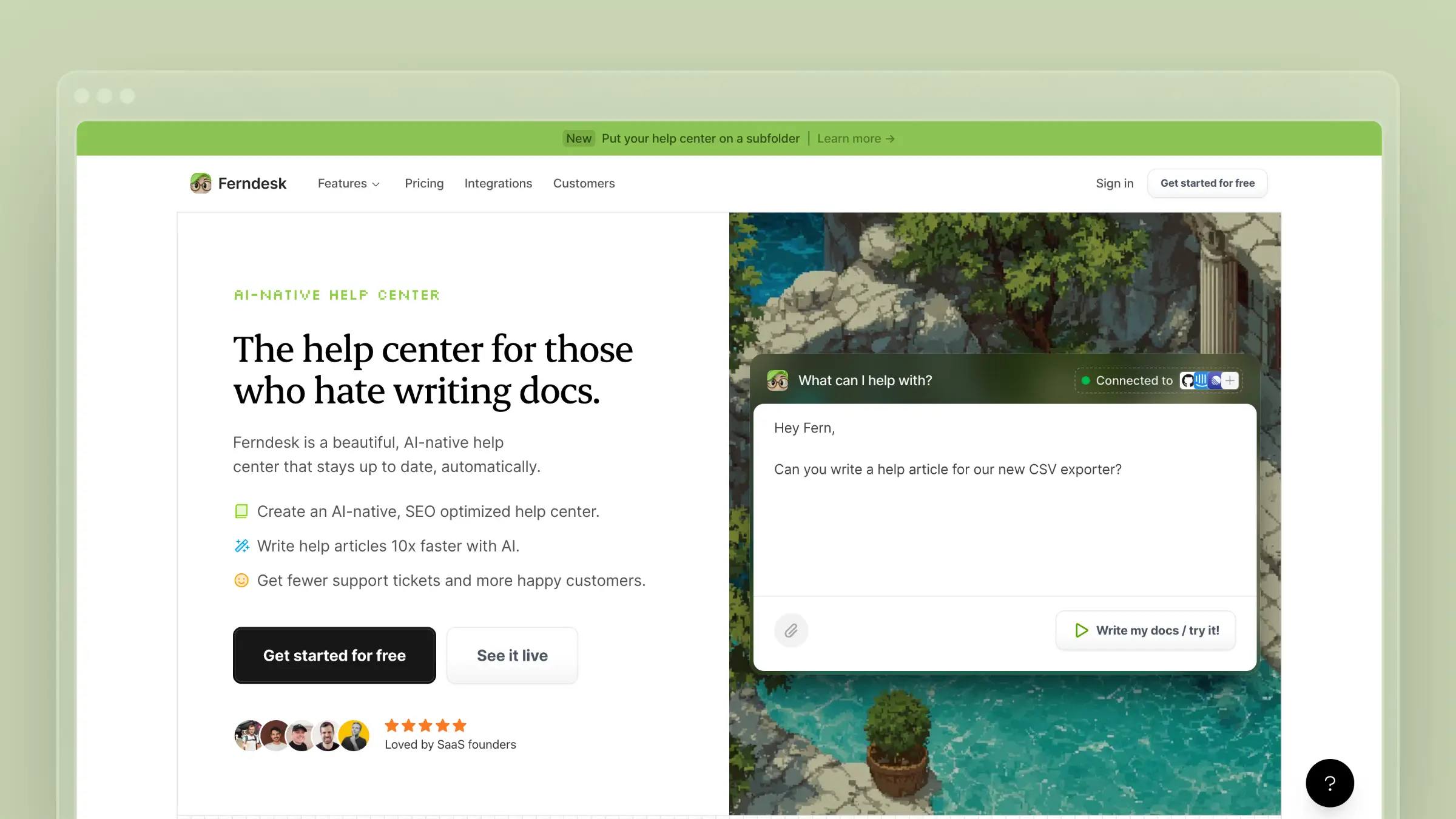
Here’s what automation actually covers from this checklist:
| This checklist item | Manual approach | With Ferndesk |
|---|---|---|
| Detect stale articles after releases | You cross-reference PRs | Fern monitors your codebase and flags affected docs |
| Identify content gaps | You read tickets weekly | Fern clusters tickets and drafts articles |
| Update screenshots | You re-capture one by one | Automatic screenshot refresh |
| Write articles for new features | You start from blank page | Fern drafts from release notes and code changes |
| Track freshness | You check manually | Continuous monitoring with alerts |
You still review what gets published. You still do quarterly structural audits. But the grunt work, the part that makes this checklist hard to sustain, is handled. (For a deeper comparison of how AI documentation generators approach this differently, we wrote a full breakdown.)
The Bare Minimum (Tape This to Your Monitor)
If nothing else sticks, do these six things:
Every Monday:
- Scan last week’s tickets. One repeat question? Write one article.
- Scan last week’s releases. One outdated doc? Fix it.
First Monday of each month:
- Check your top 10 articles for accuracy.
- Check search analytics for zero-result queries.
Every quarter:
- Full content gap analysis against support tickets.
- Delete articles with zero views and outdated content.
Six habits. That’s how to maintain a knowledge base when you’re also the person building the product. It won’t produce a perfect knowledge base, but it’ll produce one that doesn’t embarrass you when a customer links it back to you in a support thread.
And if even that feels like too much alongside shipping code and answering tickets, Ferndesk automates the detection, drafting, and updating. You review and publish. Your knowledge base stays current without you becoming a part-time technical writer.


 Book a demo