


Your support queue is growing faster than your team can handle.
Every new customer means more tickets. Every feature release spawns a dozen “how do I…?” questions. And your best support agents are spending their days answering the same questions they answered yesterday, and the day before that.
Here’s the uncomfortable truth: most of those tickets shouldn’t exist. If you’re struggling to scale your customer support, self-service is often the most impactful lever you can pull.
According to TSIA research, up to 60% of support tickets could be resolved through documentation alone. Harvard Business Review found that 81% of customers attempt to find answers themselves before contacting support. They want to self-serve, but you’re just not letting them.
This isn’t a staffing problem. It’s a self-service problem. And solving it requires rethinking how you approach customer support entirely.
In this guide, we’ll break down the self-service strategies that actually work for SaaS companies, backed by real research, proven frameworks, and practical implementation steps.
The Economics of Self-Service in SaaS
Before diving into strategy, let’s talk numbers. Because the business case for self-service isn’t just compelling. It’s overwhelming.
The cost differential is staggering. According to industry benchmarks, self-service channels cost $1.84 per contact compared to $13.50 for assisted channels. For SaaS companies specifically, the average cost per ticket ranges from $25-35.
Do the math: if you handle 1,000 tickets monthly and deflect 40% through self-service, you’re saving between $9,400 and $13,260 every month. That’s $112,800 to $159,120 annually, enough to fund an entire support hire.
But cost reduction is just the beginning.
Customer satisfaction actually increases with self-service. This seems counterintuitive until you understand what customers really want. The groundbreaking HBR study on Customer Effort Score revealed that customers don’t want to be “delighted.” They want their problems solved with minimal effort.
The research found that 94% of customers who reported low-effort experiences said they would repurchase. Meanwhile, 96% of customers with high-effort experiences reported being disloyal. Waiting 45 minutes on hold? High effort. Finding the answer in your help center in 30 seconds? Low effort.
This is why 78% of CRM leaders report that customers prefer to solve issues independently. And why 80% of high-performing service organizations offer self-service solutions, compared to only 56% of low performers.
The lesson is clear: great self-service isn’t a cost-cutting measure. It’s a customer experience strategy.
What Separates Good Self-Service from Great
If self-service is so valuable, why do most implementations fail?
Gartner’s 2024 research found that only 14% of customer service issues are fully resolved through self-service channels. And according to McKinsey, only 10% of newly built digital platforms are fully scaled or adopted by customers.
The gap between potential and reality is enormous. Here’s what bridges it.
The Three Pillars of Effective Self-Service
Wes Bush, author of The Product-Led Playbook, argues that the best SaaS products guide users to value without requiring hand-holding. His “Bowling Alley Framework” provides a mental model: without guardrails, users throw gutterballs: clicking around randomly, missing key features, bouncing before they understand the value.
Self-service works the same way. You need:
1. The Right Content (The Lane)
Your knowledge base is the bowling lane. It needs to lead customers directly to their answer. This means:
- Coverage of actual customer questions (not what you think they’ll ask)
- Content written in customer language, not internal jargon
- Clear, scannable formatting with immediate answers
- Regular updates that keep pace with your product
The problem? Most SaaS companies create documentation once and forget it. Features change, UI gets updated, and documentation slowly drifts from reality. Customers hit the knowledge base, find outdated articles, and email support anyway.
This is why tools like Ferndesk are changing the game.
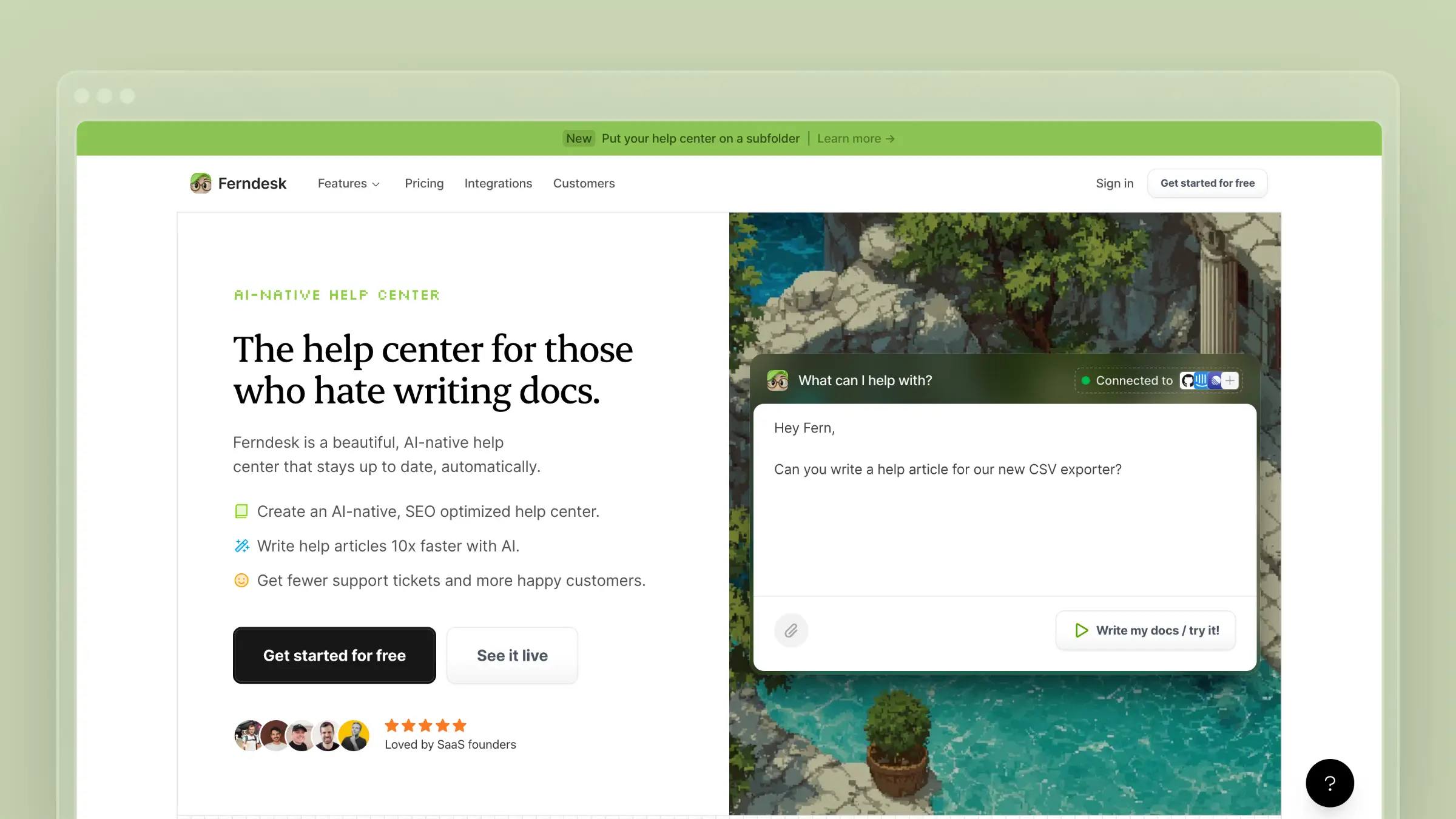
Instead of relying on manual updates, Ferndesk’s AI agent scans your support inbox, codebase, and product releases weekly to identify what content is missing, stale, or needs updating. It drafts new articles based on real customer questions, not guesswork.
2. Contextual Access (The Guardrails)
Content only works if customers can find it. Bush’s guardrails (tooltips, in-app cues, and checklists) translate directly to self-service: help needs to appear where and when customers need it.
This means:
- In-app help widgets that surface relevant articles based on context
- Smart search that understands intent, not just keywords
- Proactive suggestions when customers navigate to complex features
- SEO-optimized articles so customers find answers through Google
According to Toku research, 62% of customers prefer to resolve issues in-app. An in-app widget placed in the main interface allows users to get immediate help without leaving your product.
Ferndesk’s embeddable help widget does exactly this, surfacing the right documentation based on where customers are in your product, reducing friction to near-zero.
3. Continuous Improvement (The Scorecard)
You can’t improve what you don’t measure. Great self-service tracks:
- Search queries with zero results (content gaps)
- Articles with high traffic but negative feedback (content quality issues)
- The path from self-service to support ticket (deflection failures)
- Time-to-resolution for self-service vs. agent-assisted (efficiency metrics)
The goal isn’t to hit 100% deflection. Some issues genuinely require human intervention. The goal is to ensure customers who can self-serve are able to, and those who can’t get to a human quickly.
Support Deflection: The Core Metric
Support deflection is the percentage of customer inquiries resolved through self-service rather than live agents. It’s calculated simply:
Deflection Rate = (Deflected Tickets ÷ Total Tickets) × 100
According to Help Scout, well-designed self-service portals deflect 40-60% of incoming queries. Gartner’s research from 2018 found that companies report up to 70% reduction in call, chat, and email inquiries after implementing virtual customer assistants.
Real case studies back this up:
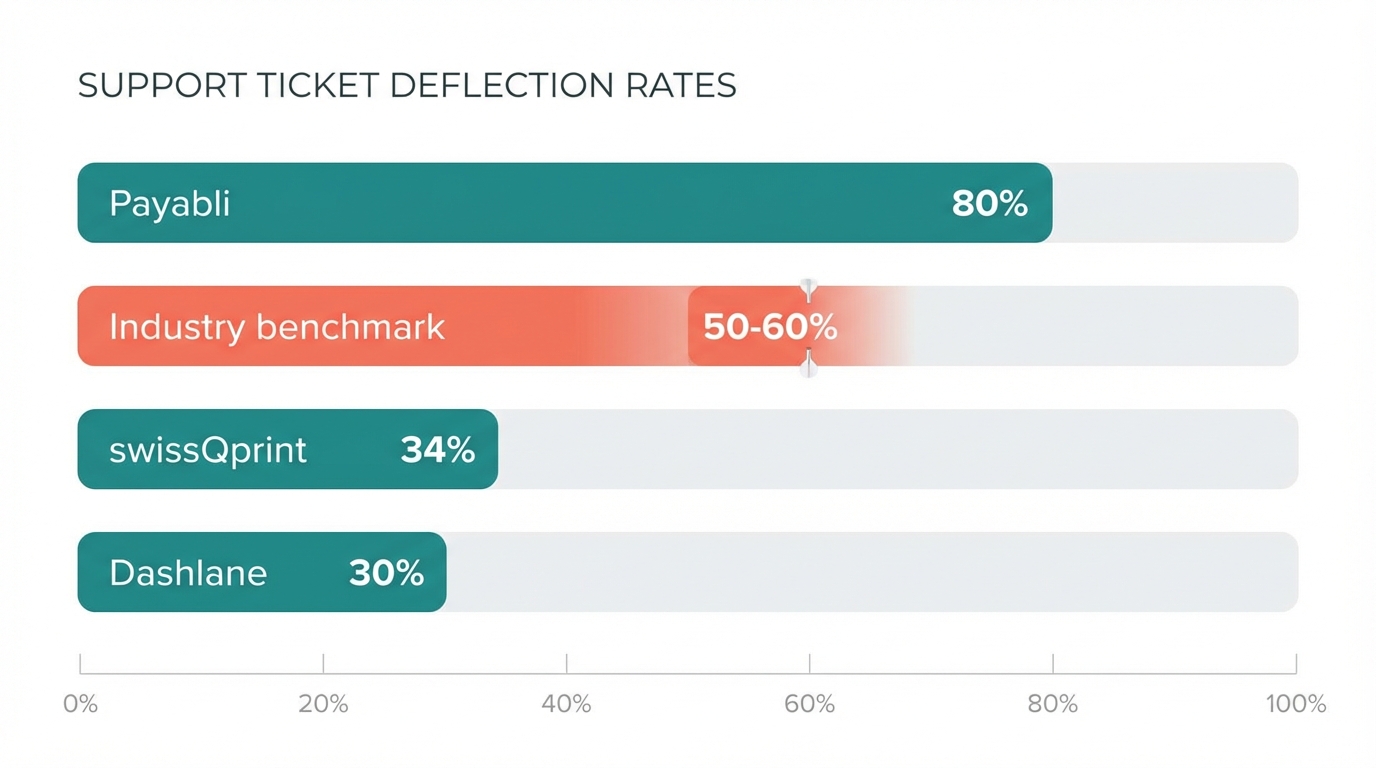
- Payabli achieved an 80% deflection rate using AI-powered documentation, outperforming the industry benchmark of 50-60%
- Dashlane reduced ticket volume for high-volume issues by 30% with expertly-crafted guides
- swissQprint reported a 34% reduction in support tickets after launching their documentation portal
- PlanetHS eliminated over 190,000 support tickets using in-app flows and smart tips
These aren’t outliers. They’re what happens when self-service is implemented properly.
How to Increase Your Deflection Rate
Start with your ticket data. Pull reports from your support platform and categorize tickets by topic. You’ll likely find that 20% of topics generate 80% of volume. Those are your high-impact documentation targets.
Create content for real questions. Don’t write documentation based on what you think customers should know. Write it based on what they actually ask. Connect your knowledge base to your support platform (Ferndesk integrates with Intercom, Help Scout, Crisp, and more) and let customer questions drive content creation.
Place help where customers are. Don’t bury your help center in a footer link. Embed it in your product. Surface relevant articles when customers hover over complex features. Make search prominent and intelligent.
Measure deflection at the point of potential ticket creation. The best self-service systems track when customers start the ticket submission process but abandon it after finding an answer. This is true deflection: customers who would have created tickets but didn’t.
Iterate weekly, not quarterly. Products change fast. Documentation that’s accurate today becomes misleading next month. Automated systems like Ferndesk audit your content regularly and flag outdated articles before customers complain.
The Product-Led Connection
The rise of self-service in SaaS isn’t happening in isolation. It’s part of a larger shift toward product-led growth (PLG).
According to OpenView’s research, product-led businesses are valued more than 30% higher than the public-market SaaS Index Fund. And ProductLed’s 2025 benchmarks show that 79% of SaaS companies have adopted PLG strategies.
Why does this matter for self-service? Because PLG and self-service share the same core philosophy: let the product (and its documentation) do the selling and supporting.
In a PLG model, customers onboard themselves. They explore features without a sales demo. They troubleshoot issues without waiting for support. As Wes Bush puts it: “By having your prospects onboard themselves, you can significantly reduce your prospect’s time-to-value and sales cycle.”
Self-service documentation is the backbone of this approach. It’s how customers:
- Learn what your product does before signing up
- Onboard without human hand-holding
- Discover features they didn’t know existed
- Troubleshoot issues without leaving your product
- Become power users who advocate for your product
This is why the most successful PLG companies treat documentation as a first-class product, not an afterthought.
AI and the Future of Self-Service
We’re in the early innings of an AI transformation in customer service.
According to Salesforce, by 2027, 50% of service cases are expected to be resolved by AI (up from 30% in 2025). McKinsey estimates that generative AI could reduce human-serviced contacts by up to 50%.
The self-service software market reflects this trajectory. It’s expected to grow from $22.08 billion in 2025 to $56.11 billion by 2030, a CAGR of 20.5%.
But here’s the nuance: AI isn’t replacing self-service. It’s supercharging it.
AI-powered search understands intent, not just keywords. When a customer asks “how do I connect my Slack,” it surfaces the right article even if the documentation title says “Slack Integration Setup.”
AI documentation agents like Ferndesk’s Fern don’t just answer questions. They write and update the documentation itself. Fern reads your codebase, support tickets, and changelogs to draft articles that get customers to success. Every week, it scans for content gaps and flags outdated information.
AI chatbots provide conversational self-service, but they’re only as good as the knowledge base behind them. A chatbot with access to outdated documentation just gives wrong answers faster.
This is why 83% of service professionals cite AI as the next big self-service trend. And why companies with AI-powered documentation see 25-45% ticket deflection with ROI multipliers of 2-5x within the first year.
The lesson: AI amplifies your self-service strategy. It doesn’t replace the need for comprehensive, accurate, well-organized documentation. It makes that documentation more powerful.
Implementation Roadmap
Ready to transform your self-service? Here’s a practical roadmap.
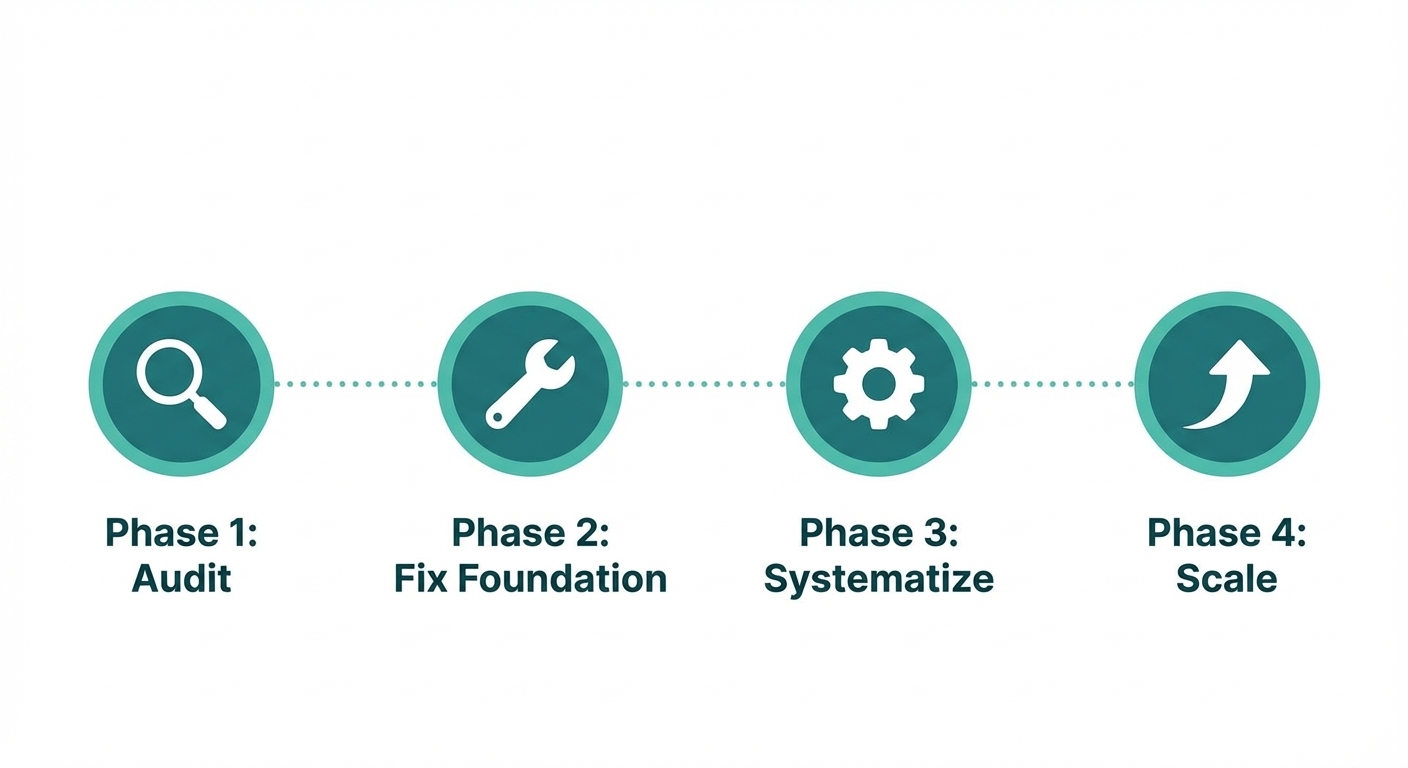
Phase 1: Audit Your Current State (Week 1)
Analyze your ticket volume.
- Export 90 days of support tickets
- Categorize by topic and frequency
- Identify the top 20 issues that drive 80% of volume
- Note which issues have documentation vs. which don’t
Evaluate your existing documentation. (Use our knowledge base maintenance checklist to structure this audit.)
- How old are your articles? When were they last updated?
- Do they cover your actual product, or a version from 6 months ago?
- Are they findable through search, both in-app and Google?
- What’s the feedback ratio (helpful vs. not helpful)?
Benchmark your current metrics.
- What’s your current deflection rate?
- What’s your average time-to-resolution for self-serve vs. agent-assisted?
- What percentage of customers visit the help center before submitting a ticket?
Phase 2: Fix the Foundation (Weeks 2-4)
Close the critical gaps. Start with the top 5 issues that generate the most tickets but have no documentation. Don’t aim for perfection. Aim for coverage. A good article today beats a perfect article next month.
Update the outdated content. Any article that references deprecated features, old UI, or incorrect workflows needs immediate attention. These create more confusion than no article at all.
Improve discoverability.
- Ensure your knowledge base is SEO-optimized
- Add an in-app help widget (Ferndesk provides this out of the box)
- Implement smart search that handles synonyms and intent
Phase 3: Systematize (Weeks 5-8)
Connect your sources of truth. Your documentation should automatically learn from:
- Support tickets (what are customers asking?)
- Product releases (what changed?)
- Customer feedback (what’s confusing?)
Tools like Ferndesk connect to your codebase, support platforms, and internal docs to identify gaps automatically. (For a comparison of documentation platforms, see our best help center software guide.)
Establish review workflows. Who approves new articles? Who’s responsible for updates when features change? Build documentation into your product development process, not around it.
Set up analytics. Track search queries, article performance, and the path from self-service to ticket creation. This data drives continuous improvement.
Phase 4: Scale (Ongoing)
Automate content maintenance. Manual documentation doesn’t scale. Use AI agents to draft new content, flag outdated articles, and ensure coverage keeps pace with your product.
Expand coverage proactively. Don’t wait for customers to ask. When you ship a new feature, documentation should ship with it. When support agents see a pattern, content should address it.
Measure and iterate. Review deflection rates monthly. Celebrate wins and investigate failures. Self-service is never “done.” It’s a continuous improvement process.
Common Mistakes to Avoid
Writing for yourself, not customers. Technical teams write documentation in technical language. Customers don’t think about “API authentication flows.” They think about “connecting my account.” Write in customer language.
Treating documentation as a one-time project. The day you publish an article, the clock starts ticking toward obsolescence. Without ongoing maintenance, your knowledge base becomes a liability.
Hiding the help center. If customers can’t find your documentation, it might as well not exist. Make it prominent, searchable, and contextually available within your product.
Optimizing for the wrong metric. Article count means nothing if articles don’t help. Focus on deflection rate, customer effort score, and feedback quality, not vanity metrics.
Ignoring the human handoff. Self-service should make it easy to reach a human when needed. Forcing customers through endless chatbot loops creates exactly the high-effort experience that destroys loyalty.
The Competitive Advantage of Great Self-Service
Here’s what your competitors don’t understand: self-service is a moat.
When your documentation is comprehensive, current, and contextually available, customers solve problems faster. They onboard without hand-holding. They discover features without demos. They become power users who advocate for your product.
When your competitors’ documentation is outdated and hard to find, their customers wait on hold. They submit tickets for basic questions. They churn because they never learned what the product could do.
According to McKinsey, companies with top-quartile customer experience strategies outperform their competition by nearly 80% in revenue growth. Those same companies have “service costs that are as much as 15-20% lower than their peers.”
Self-service is how you get there.
Getting Started Today
The gap between your current self-service and what’s possible is probably larger than you think. But closing it doesn’t require a massive initiative. It requires consistent progress.
Start with your top ticket driver. Write one article today. Set up an in-app help widget this week. Connect your knowledge base to your support platform this month.
If you want to accelerate the process, Ferndesk can audit your existing documentation, identify gaps from your support tickets, and draft articles that address real customer questions. Its AI agent Fern handles the ongoing maintenance so your team can focus on what they do best: solving complex problems that actually require human intelligence.
Your customers want to self-serve. Your business benefits when they do. The only question is whether you’ll give them the tools to succeed.
Ready to reduce your support ticket volume by 40-60%? Try Ferndesk free and see how AI-powered documentation can transform your self-service strategy.


 Book a demo