


Your help center is out of date. You know it. Your support team knows it. Your customers definitely know it.
You’ve been meaning to fix it for months. But every time you schedule “documentation week,” something more urgent comes up.
Here’s the thing: you don’t need a dedicated week to refresh your docs. You need 2 hours and a system.
This article is interactive. Check items off as you complete them.
Quick Assessment: How Bad Is It?
Before you fix anything, figure out what’s actually broken. Takes 15 minutes.
- Pull last month’s support tickets and group by topic
- Check if each one has a help article
- Open those articles. Do they match current product?
- Search your help center for your 3 newest features
If more than half your top tickets have no article (or wrong articles), you’ve got a content gap problem.
If articles exist but don’t match the product, you’ve got a staleness problem.
Most companies have both.
The 2-Hour Fix
You don’t have time for a full audit. Do this instead:
Hour 1: Kill the Worst Offenders
- Find your 5 most-viewed articles (check analytics or Google Search Console)
- Compare each to your current product. Screenshots wrong? Workflow changed?
- Fix what’s quick, delete what’s unsalvageable (wrong info is worse than no info)
Hour 2: Fill the Biggest Gap
- Find the question that keeps coming up in tickets
- Write one article answering it, like you’re explaining over chat
- Link it in onboarding emails, your support widget, everywhere obvious
You just fixed your biggest content problem in 2 hours.
Why This Keeps Happening
Help centers go stale because documentation isn’t connected to anything.
You ship a feature → no automatic trigger to document it. Customer asks a question → no automatic capture of what’s missing. UI changes → no alert that screenshots are wrong.
Your product moves fast. Your docs don’t. The gap widens every week.
The companies that keep docs fresh do one of two things:
Option 1: Process discipline. Every PR requires a docs update. Every support ticket gets tagged for content gaps. Quarterly audits are sacred. This works if you have the headcount and willpower.
Option 2: Automation. Connect your help center to your support tickets and codebase. Let software find the gaps and draft the fixes. You just review and publish.
Most growing teams can’t sustain Option 1. That’s why automated knowledge bases exist. (For a broader comparison of tools, see our best help center software guide.)
The “Never Go Stale” System
Pick the approach that fits your team:
If You Have 30 Minutes/Week
- Every Monday, look at last week’s support tickets
- Note any question that should’ve been self-served
- Either update an existing article or add it to a “to write” list
- Write one new article per week from that list
This is the minimum viable maintenance. It won’t catch everything, but it stops the bleeding.
If You Have Zero Time
This is what Ferndesk and its self-updating help center are built for.
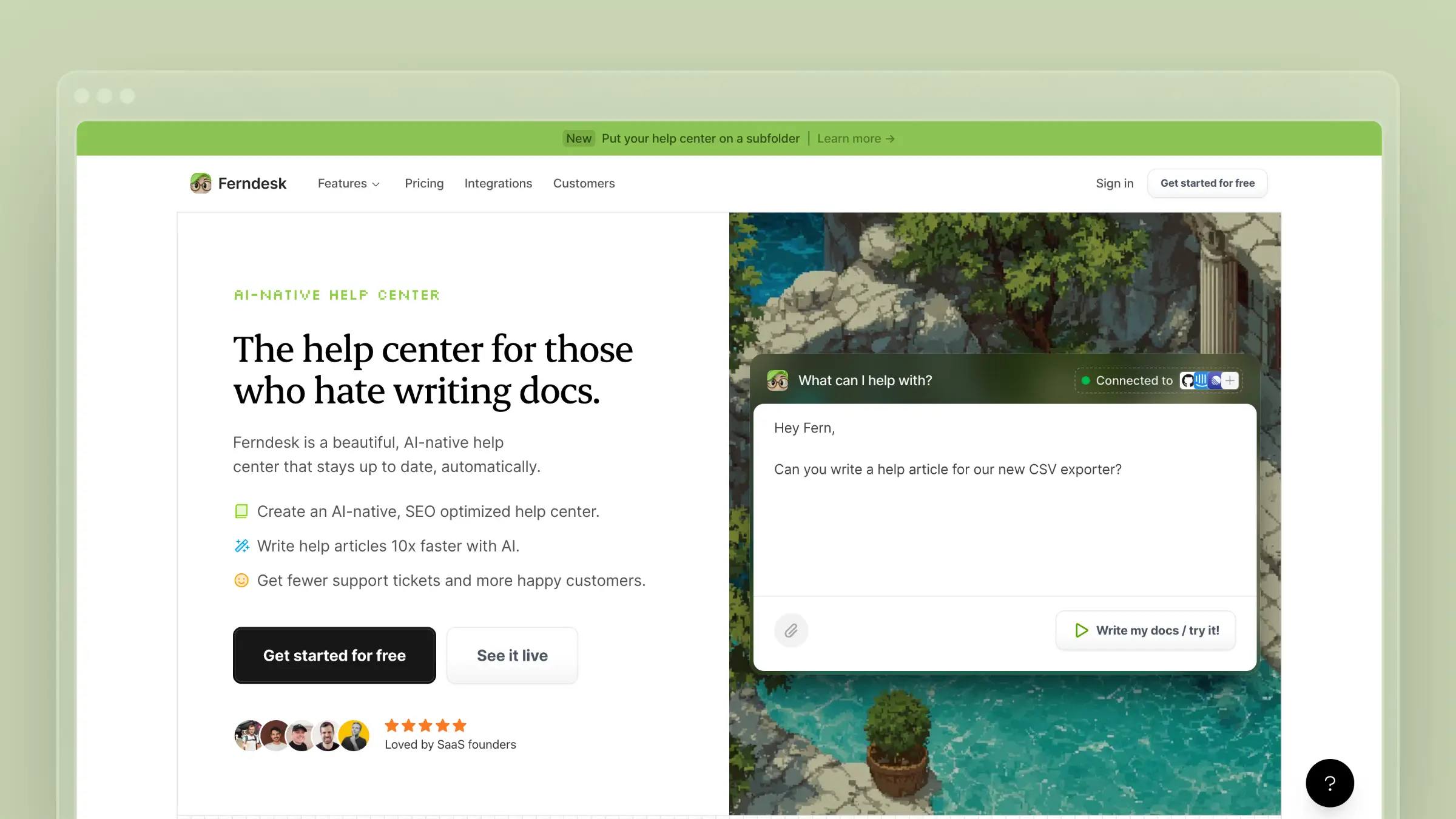
Ferndesk has an AI documentation agent that does the writing for you. Connect your support inbox and Fern analyzes your tickets, identifies patterns, researches the answers, and drafts complete articles. Connect your GitHub and Fern detects when your product changes but your docs don’t.
You can even @mention Fern directly in Linear to write docs for new features as you ship them:
The agent handles research, writing, and even suggests visuals. You review and publish. That’s it.
We built this because we got tired of the “documentation sprint” cycle: scrambling to fix months of neglect, then watching it decay again. The only sustainable answer is letting AI do the writing.
What Actually Matters
Forget the 50-point audit checklists. (Though if you want a structured approach, our knowledge base maintenance checklist covers the essentials.) Focus on three things:
1. Your top 10 articles should be accurate. These get 80% of your traffic. If they’re wrong, nothing else matters.
2. Your top 5 support questions should have articles. This is where self-service deflection happens. No article = guaranteed ticket.
3. New features need docs within a week of launch. Not perfect docs. Just something. You can improve it later.
Everything else is optimization. Get these three right first.
What Nobody Tells You
You’ll never catch up manually. If you’re behind now, shipping faster won’t help. You need either dedicated headcount or automation.
Perfect is the enemy of published. A rough article that answers the question beats a polished article that doesn’t exist. Ship fast, improve later.
Your support team knows exactly what’s broken. Ask them. They’ll give you a prioritized list in 5 minutes.
Screenshots are the biggest pain. Every UI change breaks them. Consider using fewer screenshots, or switch to short screen recordings that are more resilient to minor changes.
Next Steps
Today: Do the 15-minute assessment. Know how bad it is.
This week: Spend 2 hours on the quick fix. Update your top 5 articles, write one new one.
This month: Pick a maintenance approach. Either commit to 30 minutes weekly, or try Ferndesk and let automation handle it.
Your customers want to help themselves. 81% try to find answers before contacting support. Give them accurate docs and they’ll stop flooding your inbox.
The refresh takes 2 hours. The system takes 30 minutes a week, or zero if you automate. Either way, it’s less time than you’re spending on tickets right now.
Done with documentation busywork? Ferndesk connects to your support inbox, finds what’s missing, and drafts articles for you. You just review and publish.


 Book a demo