API documentation software for teams that ship faster than they can document
Import your OpenAPI spec and Ferndesk renders a precise, searchable reference. Then Fern writes the guides around it and keeps everything accurate as your endpoints change, in the same place as your customer help docs.
- 7-day free trial
- No credit card
- Import your OpenAPI spec

Trusted by leading SaaS companies




API documentation software turns an API specification into a published, searchable reference that developers use to build integrations.
The good tools do three jobs: render every endpoint, parameter, and response from an OpenAPI or Swagger spec; surround that reference with the authentication, quickstart, and error guides developers actually read; and keep both current as the API changes. It overlaps with API design and testing tools like Postman, but those solve a different problem. Documentation software is about publishing and maintaining the docs, not modeling or testing the API. Ferndesk adds the part most tools leave to you: an AI agent that writes the guides and keeps everything accurate as you ship.
The reference renders once, then quietly goes wrong
Most API documentation tools hand you a beautiful reference on day one and leave keeping it accurate to you. Here is what that turns into, and what Ferndesk does instead.
A standalone portal that drifts from your spec
You generated the reference once, then shipped for six months. Half the fields are renamed, two endpoints are gone, and nobody noticed until a developer opened a support ticket about an error code that no longer exists.
Guides nobody updates after a launch
The quickstart and the auth walkthrough were written for last year API. Reference docs at least track the spec. The narrative around them rots quietly, because writing it up properly always loses to shipping the next thing.
API docs in one tool, help docs in another
Your reference lives in a dev portal and your product help lives somewhere else, so search reaches one but not the other, and a developer who needs both ends up with two tabs and no single answer.
Hand edits every time the API changes
Every renamed parameter means someone re-reads the docs, finds the affected pages, and edits them by hand. It is the kind of chore that gets skipped until the docs and the API openly disagree.
Three categories the buyer search blurs together
Search for API documentation software and you get a mix of doc renderers, spec design tools, and general wikis. They are related, but they are not the same purchase. Here is the clean version.
API documentation
The published reference plus the guides developers read to build an integration. This is what Ferndesk does: render the spec, write the narrative, keep both current.
Reference, guides, search, hosting
API design and testing
Where you model, mock, and test the API itself. Postman, Stoplight, and Apidog lead here. Useful before the spec is final, but they are not where your customers read the docs.
Spec design, mocking, test runs
Help center and product docs
The customer-facing articles around the API: onboarding, troubleshooting, billing. Most teams keep these apart from the reference. Ferndesk keeps them in one searchable place.
Articles, widget, deflection
If you are still shortlisting renderers, our best API documentation tools guide compares seven with current pricing.
From spec import to a reference developers can search
The table stakes are all here. The difference is that you do not maintain any of it by hand.
OpenAPI and Swagger import
Upload a JSON or YAML definition or point Ferndesk at a URL. She validates the spec and renders every endpoint into a structured reference, and imports an existing reference from GitBook or Mintlify if you are switching.
Operation pages with schemas
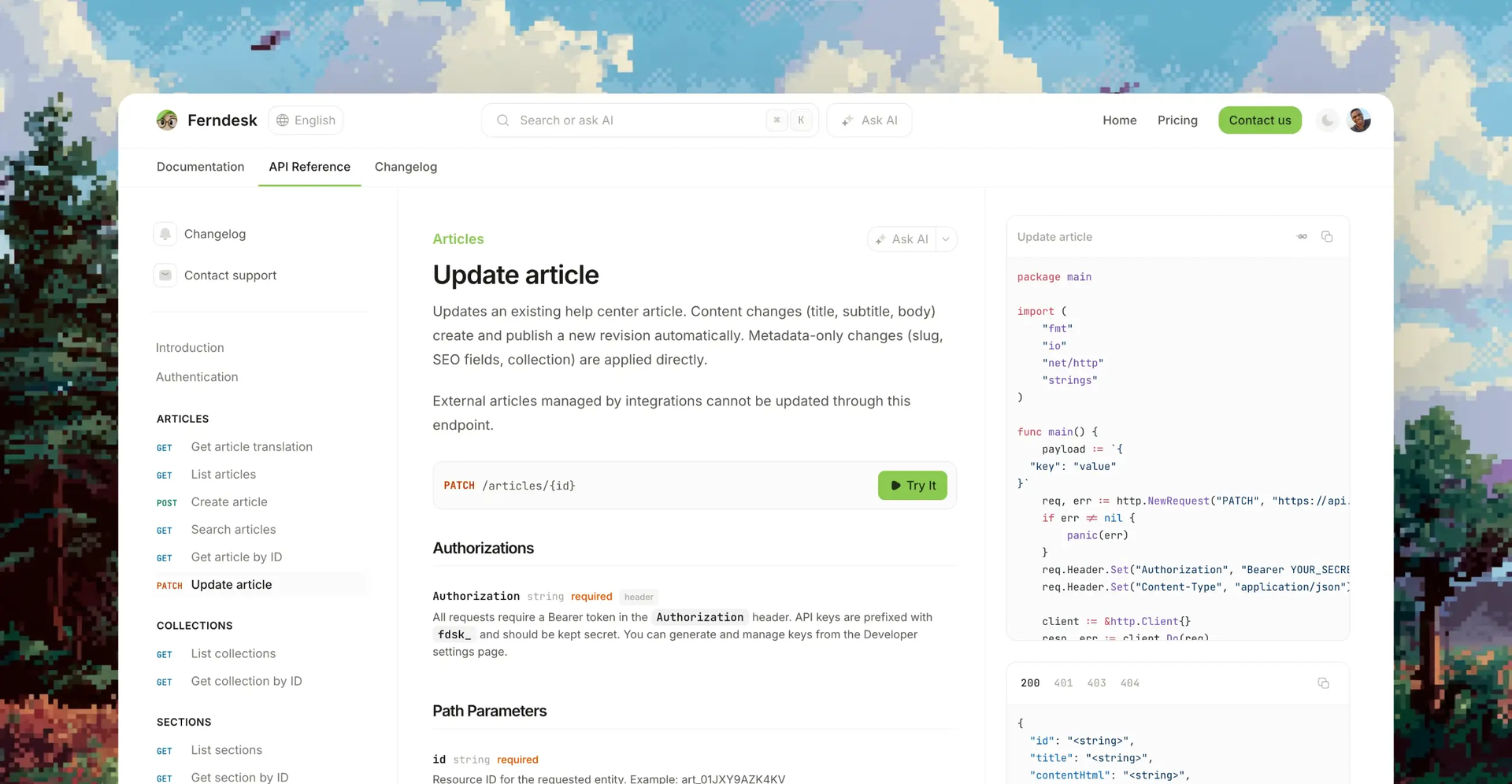
Each endpoint gets its own page with parameters, request and response schemas, and status codes, generated from the spec and grouped by your tags so the reference reads like a product.
Authentication that reads like docs
API key, bearer, and OAuth schemes rendered as real walkthroughs: where the credential goes, how to get one, what a failed auth looks like. Not a one-line note developers have to decode.
Code samples and a playground
Copy-ready samples for each operation and an interactive console, so a developer can run a call from the docs instead of wiring up Postman to find out what the response shape is.
One search across docs and reference
A single search box and AI agent covers your endpoints and your help articles together, so a question phrased as a concept lands on the right operation and the guide that explains it.
The guides, not just the reference
An endpoint list is not documentation. Fern reads your codebase to write the quickstarts, auth flows, and error handling that turn a reference into something a developer can actually ship against.
Your domain, your help center
Serve docs on your own domain or as a subfolder, with the reference, the guides, and your customer help articles in one place that builds your domain authority instead of a vendor subdomain.
Always in step with the spec
Ferndesk tracks the spec your API is built from and notices the moment it changes, so a new endpoint or a renamed field shows up in the docs without anyone remembering to sync it.
Migrate without losing rankings
Import your current docs, keep every old URL alive with redirects, and carry your search equity over. Most teams are live the same day they import their spec.
Docs that maintain themselves from your spec and your code
Every other tool on this page waits for a human to notice the reference went stale. Ferndesk watches where the API actually changes and brings the work to you already drafted.
Fern reads the spec and the code behind it
She renders the reference from your OpenAPI definition and reads the codebase around it, so the docs reflect what the API actually does, not what the spec said three releases ago.
She writes the guides, not just the reference
Quickstarts, authentication walkthroughs, common workflows, error handling. The narrative developers need to go from a list of endpoints to a working integration, drafted from how the API is built.
Ship a change and the docs follow
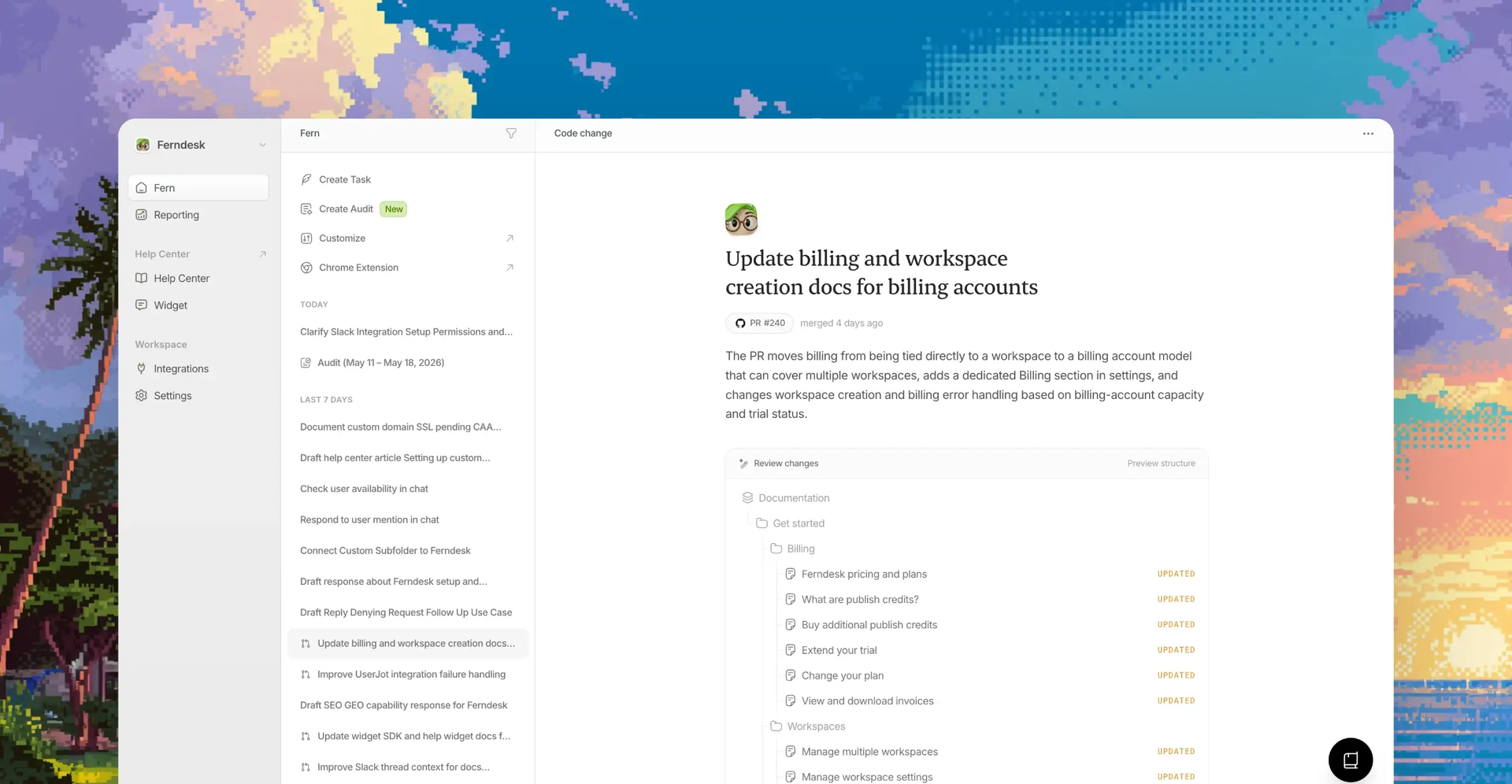
Add an endpoint, rename a field, or return a new error code, and Fern finds every page the change made wrong, including the related help articles, and drafts the edits.
Humans review before anything publishes
The work arrives already drafted, but nothing goes live without a person approving it. You keep editorial control, and your URLs, redirects, and SEO stay intact.
Ship the endpoint, find the docs already updated
The reference pages your change touched, the guides that mention the old behaviour, the examples that need a new field. Fern drafts the edits and puts them in your task list. You approve the ones that look right and publish in a click, instead of hunting for what your last release just made wrong.
How Ferndesk compares to the doc renderers
We build documentation software for a living, so weigh the first column accordingly. Everything below is accurate as of 2026. API design and testing tools like Postman, Stoplight, and Apidog sit outside this table: they model and test specs, they are not where your docs get published.
| Ferndesk | Mintlify | GitBook | ReadMe | Redocly | Docusaurus | |
|---|---|---|---|---|---|---|
| Renders a reference from OpenAPI | Via blocks | Via plugin | ||||
| Self-maintains docs from code and PRs | Code-level | |||||
| Writes the narrative guides for you | ||||||
| API reference and help center together | Wiki side | |||||
| Interactive try-it playground | Pro only | |||||
| Hosted, no infra to run | ||||||
| Starting price | $39/mo | $300/mo | $65/mo | $250/mo | $99/mo | Free, self-hosted |
Ferndesk customers save 20 hours a month on average
Founders who used to dread updating docs now ship features every week, and Fern keeps every help article accurate.
“If you struggle to keep your help docs up to date, you’re going to love Ferndesk.”
 Watch the story
“I do in 5 minutes what used to take one hour. I think it easily saves me 20h a month. We ship features every week. Updating docs is hell. Now Ferndesk makes it so easy I can just ship more and scale!”
 Tristan Roth Founder, ISMS Copilot
“I used to never update my articles, just write them once and they get stale right from day 1. Now my docs stay up to date automatically.”
 Fed Founder, GummySearch
“Being able to see exactly what customers are searching for and what they can’t find answers to. That alone has been huge. My support requests have dropped significantly since I started using it.”
 Laura Elizabeth Founder, Client Portal
“I simply connected Discord, Intercom, and GitHub, and within five minutes I had more than 20 tailor-made draft articles generated.”
 Richie McIlroy Founder, Cap
“The Ferndesk audits have been really useful to discover gaps in our help articles and quickly fill them. We’re already seeing a reduction in our customer churn because of this.”
 Emmett Founder, PixelFlow
“Connecting our GitHub repo lets Fern read latest file changes, create new articles and update old ones. Ferndesk easily saves us 20+ hours per week.”
 David Oragui Founder, We Are Distributed
“Many tools slap on some AI features so they can ride the AI wave, but they don’t actually add real value. Ferndesk is different, it uses AI in a way that is incredibly helpful for both the Mallow team and our customers.”
 Chipper Whatcott Co-founder, Mallow
“We just launched new help docs and I’m so happy with them. Clean new design, super fast with a better search, and AI chat built in that actually works so well we’re even using it to help with support tickets.”
 Bryce Adams Founder, Metorik
“This tool is absolutely magical! I’ve been using it firsthand in Senja and wow, it’s saving me so much time. Total game changer.”
 Rotimi Best Engineer, Senja
The agent-ready API docs checklist
Whatever tool you pick, the reference is only as good as the spec behind it. And the same things that make docs good for developers make them good for the AI agents now answering on your behalf.
A valid, complete spec
Every endpoint present, no broken references, operation IDs that stay stable across releases.
Real examples on every operation
Request and response examples, not just schemas. Examples are what developers copy and what agents ground answers on.
Authentication described in words
Each scheme explained: where the credential goes, how to get one, what a rejection looks like.
Documented error responses
The failure cases, not only the happy path. Status codes, error shapes, and what to do about each.
Tags that group operations
Logical grouping so the reference reads as a product, not an alphabetical dump of routes.
A changelog and redirect plan
A versioning and URL strategy so links keep working and your search equity survives every change.
Check your spec before it becomes your docs
Run your OpenAPI spec through our free validator. It scores syntax, completeness, examples, authentication, and response docs, then tells you what to fix. No account needed.
Ferndesk is not the right API docs tool for everyone
- You ship constantly and the reference cannot keep up by hand.
- You want the guides written and maintained, not just the endpoints rendered.
- You want your API docs and your customer help center in one searchable place.
- You want AI answers developers can trust, which means the docs underneath have to be current.
- You need API design, mocking, and automated testing. Postman and Stoplight own that job.
- You want a self-hosted, open-source docs site your engineers fully control.
- You only need a developer portal and have no help-center or support-docs side at all.
Bring your spec and your existing docs, keep your rankings
Import your OpenAPI definition and your current reference, keep every old URL alive with redirects, and host under a subfolder on your own domain so your search equity compounds where it already lives. Most teams import their spec and serve their first AI answers the same day.
Go deeper on API and product docs
Seven tools compared with current pricing and where each one fits.
Score your spec for docs and agent readiness before you publish.
How Fern turns merged pull requests into accurate documentation.
How Fern keeps every doc accurate as your product changes.
Where Mintlify fits and the tools worth weighing against it.
Options when GitBook is not the right home for your docs.
API documentation software FAQ
Never write another help article.
With Ferndesk, the only help center that never goes out of date. Sign up today and ask Fern to write your first few articles.