


I have a soft spot for bootstrapped companies. KnowledgeOwl is a seven-person team out of Colorado that’s never taken a dollar of outside funding, pulled in around $750K in annual revenue, and built a knowledge base platform used by thousands of authors and teams. The CEO calls herself “Chief Executive Owl.” They’re B Corp certified and want to eventually become employee-owned.
All of which is genuinely great. But you’re not buying a company story, you’re buying software. And the software starts at $100/month for a single author without even a custom domain. So let’s talk about what you actually get.
Who Uses KnowledgeOwl?
Mostly mid-size companies (20-249 employees) in the US. Support teams, SaaS companies, training departments, call centers. They’re a small player in the knowledge base category, well behind Confluence, Zendesk Guide, and Document360 in adoption.
The platform works for both internal knowledge bases (employee SOPs, onboarding docs) and external help centers (customer-facing documentation). It’s a generalist tool, not purpose-built for any specific vertical.
KnowledgeOwl Pricing at a Glance
The pricing model sounds clean: pay per author, readers are free. But it gets complicated fast. Each additional author is $25/month. Each additional knowledge base is $50/month. And the plan tiers gate critical features like custom domains, APIs, and SSO behind expensive jumps.
| Plan | Price | Articles | AI Credits/mo | Key Differences |
|---|---|---|---|---|
| Basic | $100/month | 1,000 | 25 | No custom domain, no API, no SSO |
| Pro | $250/month | 2,500 | 100 | Custom domain, API, HTML/CSS/JS |
| Business | $500/month | 5,000 | 250 | SSO, HIPAA BAA, 99.5% SLA |
| Enterprise | $1,125+/month | Custom | 1,000+ | Dedicated account manager, 99.9% SLA |
30-day free trial. No credit card required. Annual billing saves 10%.
Quick math: 5 authors and 2 knowledge bases on the Pro plan runs $250 + (4 x $25) + (1 x $50) = $400/month. The sticker price is misleading.
For a full breakdown with team scenarios, see our KnowledgeOwl pricing deep-dive.
The Plans, Honestly
Basic ($100/month) gives you a single author, a single knowledge base, keyword search, and 25 AI credits per month. You don’t get a custom domain, API access, or any real customization. For $100/month, that’s a tough sell. HelpDocs gives you custom domains at $49/month. Ferndesk Pro includes unlimited AI drafting at $149/month or $1,490/year.
Pro ($250/month) is where it gets usable. Custom domain, API, full HTML/CSS/JS control, semantic search, and 100 AI credits. This is the plan most teams would actually need, which means KnowledgeOwl’s real starting price for serious use is $250, not $100.
Business ($500/month) adds SSO, HIPAA compliance, and an SLA. For a 10-person team with 2 knowledge bases, you’re looking at $775/month ($9,300/year). That’s enterprise pricing for what is, at its core, a documentation editor with a search bar.
Enterprise ($1,125+/month) gets you a dedicated account manager and a 99.9% SLA. Custom everything.
The AI Features
KnowledgeOwl recently bolted on AI across the platform. “Bolted on” is deliberate phrasing here, because the features feel additive rather than foundational.
Semantic search is the best of the bunch. It actually understands what people mean rather than just matching keywords. Handles typos, synonyms, and vague queries well. You can run it in hybrid mode (semantic + keyword) or pure semantic. This is a genuine improvement over their older search and one of the few AI features that feels well-integrated.
The AI chatbot trains on your knowledge base and answers questions with source citations. It’s fine. It works the way you’d expect a RAG chatbot to work in 2026. Customize the tone, embed it on your site, readers can thumbs-up/down responses. Nothing groundbreaking, but functional.
AI article drafting generates article stubs from prompts and can enforce style guides. Useful for getting a first draft down, but you’re still doing the real work of editing, fact-checking, and publishing.
The catch with all of this: everything runs on a credit system. The Basic plan gets 25 credits per month that don’t roll over. A chatbot on a busy help center could burn through that in a day or two. You can buy extra credits, but unused ones from your plan disappear each month. You either pay more for credits, live without AI for most of the month, or upgrade to a plan that costs 2.5x more.
What KnowledgeOwl Does Well
The standout feature is reader group permissions. You can segment your audience into groups and show different content to each: internal vs. external readers, free vs. paid users, different customer tiers. Users consistently call this the platform’s killer feature, and they’re right. It’s genuinely more granular than what most competitors offer.
The support experience is personal. With seven employees, you’re often talking to founders directly when you need help. Feature requests actually get built. If you’ve ever submitted a ticket to Zendesk and received a form letter from a bot, you’ll appreciate the difference.
The editor is simple and focused. Non-technical people can publish articles without training. There’s no learning curve to speak of for basic content creation. Categories, tags, article statuses (draft, published, needs review) provide enough structure without overwhelming.
B Corp certification means 25% discounts for nonprofits and purpose-driven organizations. If you’re a social enterprise or NGO shopping for documentation tools, this makes KnowledgeOwl notably cheaper than the sticker price.
What KnowledgeOwl Doesn’t Do
There’s no connection between your product and your documentation. When you ship a new feature, rename a button, or deprecate an API endpoint, KnowledgeOwl has no idea. You’re the one who has to remember which articles mention the old behavior and go update them one by one.
There’s no support ticket analysis. You can’t connect your helpdesk and have the system identify what questions keep coming up, or automatically generate articles from common patterns.
There’s no codebase integration. Your GitHub repo and your knowledge base are separate universes. Documentation drift between releases is invisible until a customer complains.
The “Needs Review” flag exists, but it’s manual. Nobody’s scanning your 500 articles looking for outdated screenshots or references to features you removed six months ago. That’s on you.
And there’s no real-time collaboration. Two people can edit the same article simultaneously with no conflict detection or merge resolution. Whoever saves last wins, and the other person’s work disappears.
The Limitations
The small team is a double-edged sword. Personal support is great, but seven people generating $750K in revenue doesn’t leave room for aggressive R&D. Competitors with venture backing are shipping AI features weekly. KnowledgeOwl ships them quarterly at best. If you’re betting on the product evolving rapidly, the math isn’t in your favor.
Customization beyond basics requires a developer. The Pro plan unlocks HTML/CSS/JS access, but “access” and “ability to use it” are different things. Non-technical teams hit a wall fast when they want anything beyond the default theme.
No SOC 2 certification. Enterprise security teams often require this. KnowledgeOwl’s security page lists PCI-A compliance, GDPR, and weekly vulnerability scans, but no SOC 2.
Article limits force upgrades. If you hit 1,000 articles on Basic or 2,500 on Pro, you’re paying for the next tier regardless of whether you need the other features. Your content volume shouldn’t be a pricing lever, but here it is.
Analytics are basic. Page views, search terms, zero-result queries. Enough to know what’s happening at a surface level, not enough to make informed content strategy decisions. Most users end up adding Google Analytics separately.
When KnowledgeOwl Makes Sense
Choose KnowledgeOwl if reader group permissions are truly critical to your use case, if you’re a nonprofit eligible for the 25% discount, or if you specifically want to support a bootstrapped, values-driven company. It also works if you’re a single author with a modest content library who values simplicity over power.
When to Consider Alternatives
If your team is growing (per-author fees compound fast), if you need documentation that stays current without constant manual effort, if AI credits feel like an artificial constraint, or if $250/month for a custom domain feels steep when HelpDocs and GitBook offer them at a fraction of the price.
For a broader comparison, see our best help center software guide or our SaaS-specific recommendations.
How Ferndesk Compares
| Feature | KnowledgeOwl | Ferndesk |
|---|---|---|
| Starting price | $100/month (1 author) | $149/month |
| AI features | Credit-limited (25-250/mo) | Pro, unlimited drafting |
| Automatic content updates | No | Yes (from codebase) |
| Support ticket analysis | No | Up to 5,000 tickets/month |
| Content gap detection | Manual only | Automated |
| Codebase integration | No | GitHub authoring |
| Custom domain | Pro+ ($250/mo) | Pro |
| Per-author pricing | $25/month each | $10/month after 5 |
KnowledgeOwl gives you an editor and says “go write.” The AI helps you draft faster, but you’re still the one deciding what needs writing, what’s gone stale, and what your customers are actually confused about. At $100-500/month (before add-on authors), that’s a lot of money for a tool that requires constant manual attention.
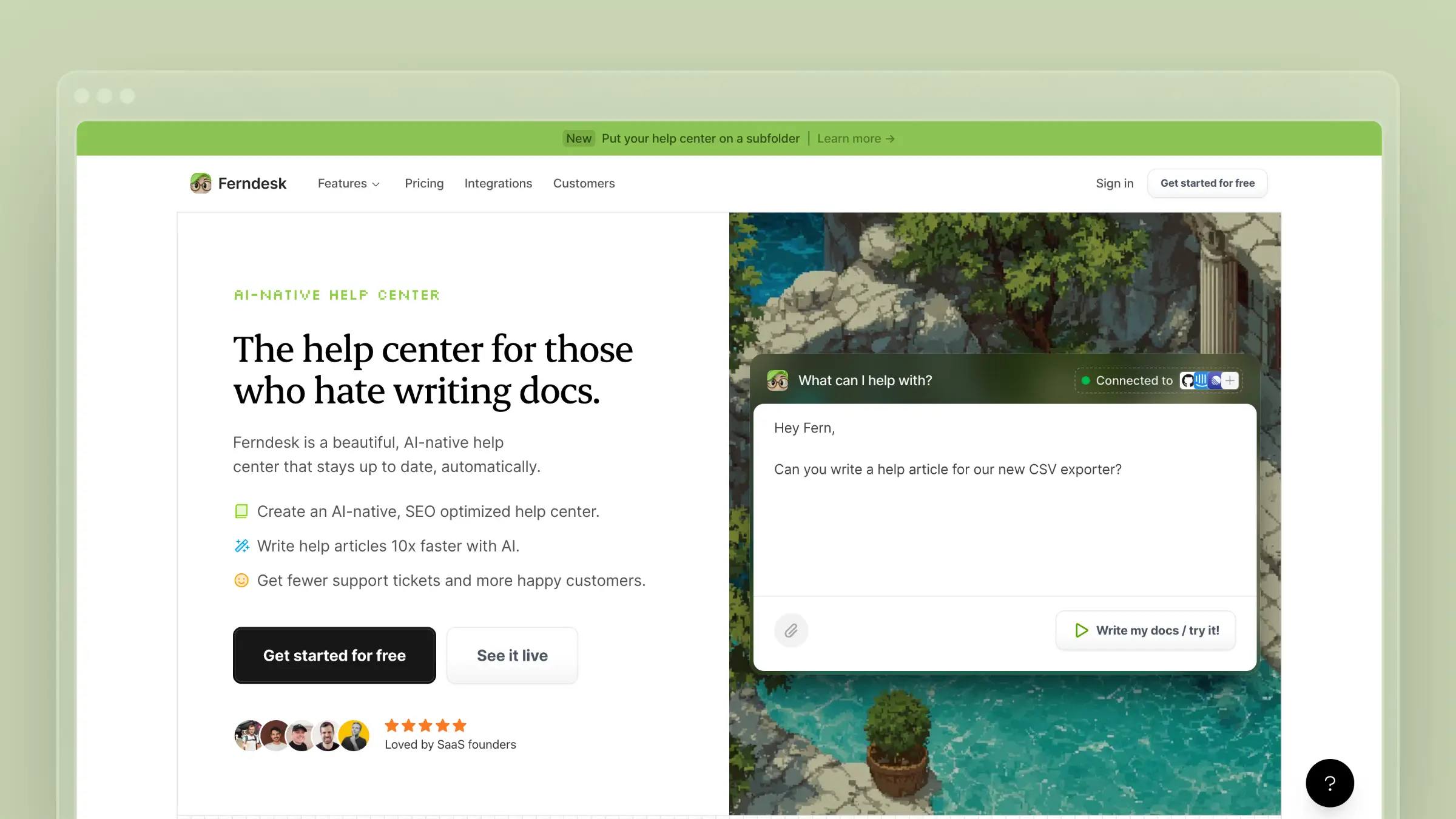
Ferndesk takes a different approach. Fern (our AI agent) reads your codebase, watches your support tickets, and actively maintains your help center. When you push a code change that affects documentation, Fern flags the update. When customers keep asking about something you haven’t documented, Fern notices and proposes an article. You review, approve, and move on.
The Credit Problem
KnowledgeOwl’s AI credit system creates a weird dynamic where you’re disincentivized from using the AI features you’re paying for. A customer-facing chatbot on 25 credits/month is basically decoration. Even the Business plan’s 250 credits has a ceiling. Ferndesk doesn’t meter AI drafting. The agent runs continuously without you watching a drafting credit counter tick down.
The Price Difference
Five authors on KnowledgeOwl Pro: $250 + $100 (extra authors) = $350/month ($4,200/year).
Five team members on Ferndesk Pro: $149/month or $1,490/year.
That’s $2,710/year back in your pocket, plus you get proactive documentation maintenance that KnowledgeOwl doesn’t offer at any tier.
Bottom Line
KnowledgeOwl is a decent, simple knowledge base with one truly excellent feature (reader groups) and a team that genuinely cares about their customers. If you’re a single author at a nonprofit who needs audience segmentation, it’s a solid pick.
For everyone else, the economics are hard. The per-author model, AI credit caps, feature-gating of basics like custom domains, and the small development team all point toward a product that’s charging enterprise prices without enterprise capabilities. And none of those prices buy you documentation that keeps itself current.
If that last part matters (and if you’re building software, it should), Ferndesk Pro costs $149/month or $1,490/year. Fern reads your codebase, analyzes your support tickets, and keeps your help center current with unlimited AI drafting and five editors included.


 Book a demo