

About a third of the signups we surveyed at Ferndesk between September and mid November picked “AI assistant” when we asked how they found us. Over that same stretch, our web analytics showed only a handful of visits with an AI assistant as the referrer.
Buyers ask ChatGPT what software to buy, read the answer, and type your name into a new tab later. I work on getting Ferndesk recommended across these assistants myself, and this is what I would tell another founder who searched their category, saw competitors instead, and wanted to know how to rank in ChatGPT.
TL;DR
- To rank in ChatGPT, get onto the third-party roundups, review sites, and forum threads AI search cites, then make your site and docs easy to crawl and quote.
- Allow
OAI-SearchBotinrobots.txtand check your firewall rules so ChatGPT search can read your pages, even if you blockGPTBotfrom training.- Pitch ranking “best of” posts with useful facts, collect real G2 and Capterra reviews, and join Reddit and YouTube discussions with disclosure.
- Put pricing, comparisons, and answers in plain HTML with clear headings, real numbers, and FAQ and Article structured data.
- Keep your public help center accurate on your domain, because assistants pull feature and setup answers straight from your docs.
How ChatGPT picks tools to recommend
Ranking in ChatGPT means your product is named or cited when someone asks ChatGPT a question in your category.
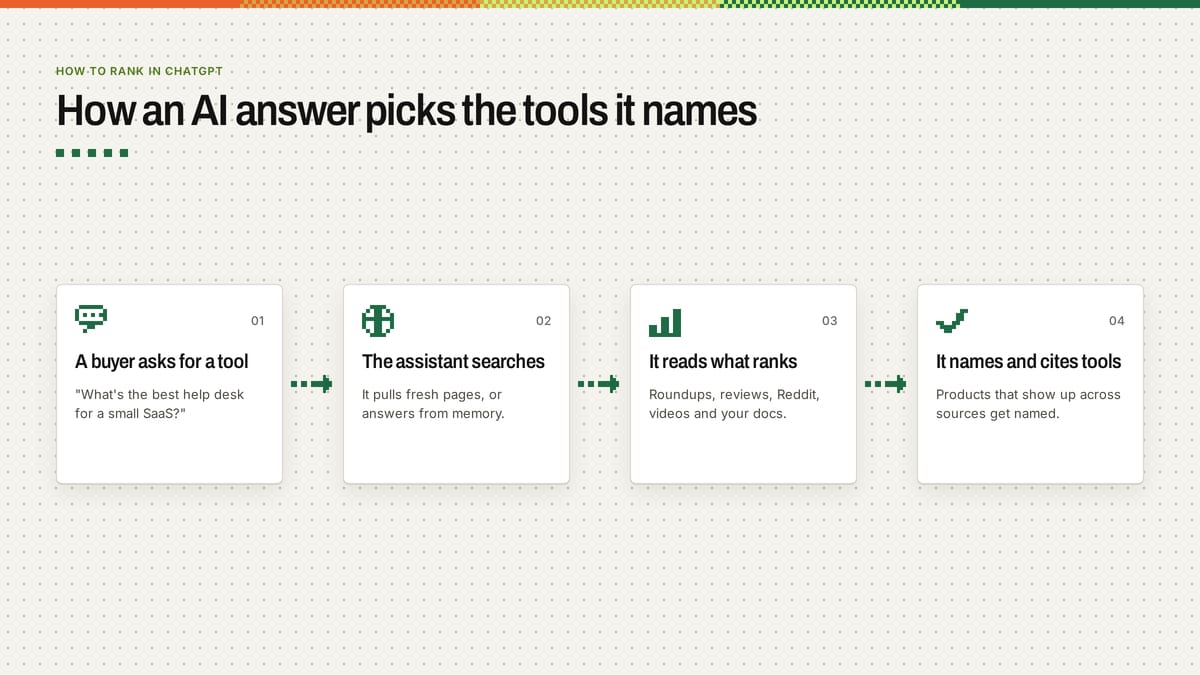
ChatGPT recommends software through two paths, and knowing which one you face decides what to work on. The first path is training data, which covers everything the model absorbed before its cutoff. You cannot edit that memory, and it only updates when a lab trains a new model.
The second path is live web search. Per OpenAI’s help center on searching the web with ChatGPT, the assistant searches automatically when a question needs current information, or when a user turns search on. This relies on retrieval-augmented generation, or RAG, where the model fetches live pages, reads snippets, and writes an answer with citations you can inspect under “View sources”.
You cannot edit training memory today, so your practical leverage sits in live web search. ChatGPT’s web search uses search providers to find pages before reading them. Pages that rank well in standard search are easier to retrieve, so checking that your site is indexed in both Google and Bing is worth ten minutes.
Nobody outside OpenAI knows the exact ChatGPT ranking factors or how sources are weighted. When buyers ask how to make ChatGPT recommend software, the model looks for independent consensus rather than trusting one vendor page. That is why “best X for Y” prompts lean on third-party lists, review sites, Reddit, YouTube, and your own pricing or help pages.
People call this work generative engine optimization, or GEO, and answer engine optimization, or AEO. Strip away the acronyms, and ChatGPT SEO is mostly SEO done well plus a few checks for machine readability.
| Source | What the assistant gets from it | What you can do |
|---|---|---|
| Roundup and “best of” posts | Category shortlists and positioning | Pitch editors with a trial, screenshots, and fit |
| Review sites like G2 and Capterra | Customer sentiment and use cases | Ask active customers for honest, specific reviews |
| Reddit and forums | Unfiltered user opinions and tradeoffs | Answer questions honestly and disclose your role |
| YouTube | Walkthroughs and creator reviews | Publish demos and partner with niche creators |
| Your own site, pricing and comparison pages | Verified plans, features, and limits | Keep facts in plain HTML with headings and dates |
| Your help center and docs | Exact setup steps and edge cases | Host public docs on your domain and keep them current |
Get onto the pages AI cites
When I pulled Google’s results for “how to rank in chatgpt” on Nov 26, 2026, the AI Overview at the top cited Reddit threads, YouTube videos, and a LinkedIn post next to marketing blogs. That single search shows the pattern clearly. The answer is assembled mostly from third-party pages rather than a brand’s own site.
This explains why ChatGPT cites competitors even when your product is stronger. If rivals appear across five roundups and twenty forum threads while you appear in none, live search has plenty of evidence for them and none for you. Learning how to get cited by ChatGPT starts on the pages search already pulls, even though nobody outside the labs knows the exact weighting.
Pitch existing third-party lists
Find the “best of” and comparison posts ranking on page one for your category. Email the author with something useful: a one-sentence description of who your tool fits, a trial account, and clean screenshots. Updating a ranking article moves much faster than trying to rank a brand-new post from scratch.
Collect G2 and Capterra reviews
Buyers and AI assistants both check G2 and Capterra when comparing software. Ask active customers for an honest review after a smooth onboarding or solved support ticket. Specific reviews naming real workflows give models concrete proof of what your product does.
Join Reddit and YouTube honestly
Reddit threads and YouTube demos appear constantly across ChatGPT, Perplexity, Gemini, and Google AI Overviews. Reply to relevant threads with plain, helpful advice and disclose that you built or work on the tool. Undisclosed promotion gets spotted fast. On YouTube, skip studio polish and post short walkthroughs answering real buyer questions, or partner with creators in your niche.
Repeat one clear product sentence
Search systems treat your company as an entity, a distinct record linking your name to a category and audience. Write one plain sentence with your category and target user, then reuse it across your homepage, G2 bio, directories, and podcast intros. Consistent brand mentions support E-E-A-T, Google’s shorthand for experience, expertise, authoritativeness, and trustworthiness.
Make your own site easy to quote
Once third-party pages name you, assistants check your own site to verify pricing, integrations, and fit. Many SaaS sites lose citations here because crawlers get blocked or hit empty JavaScript shells. These first-party fixes are the best documented part of SEO for ChatGPT.
Allow the OpenAI search crawler
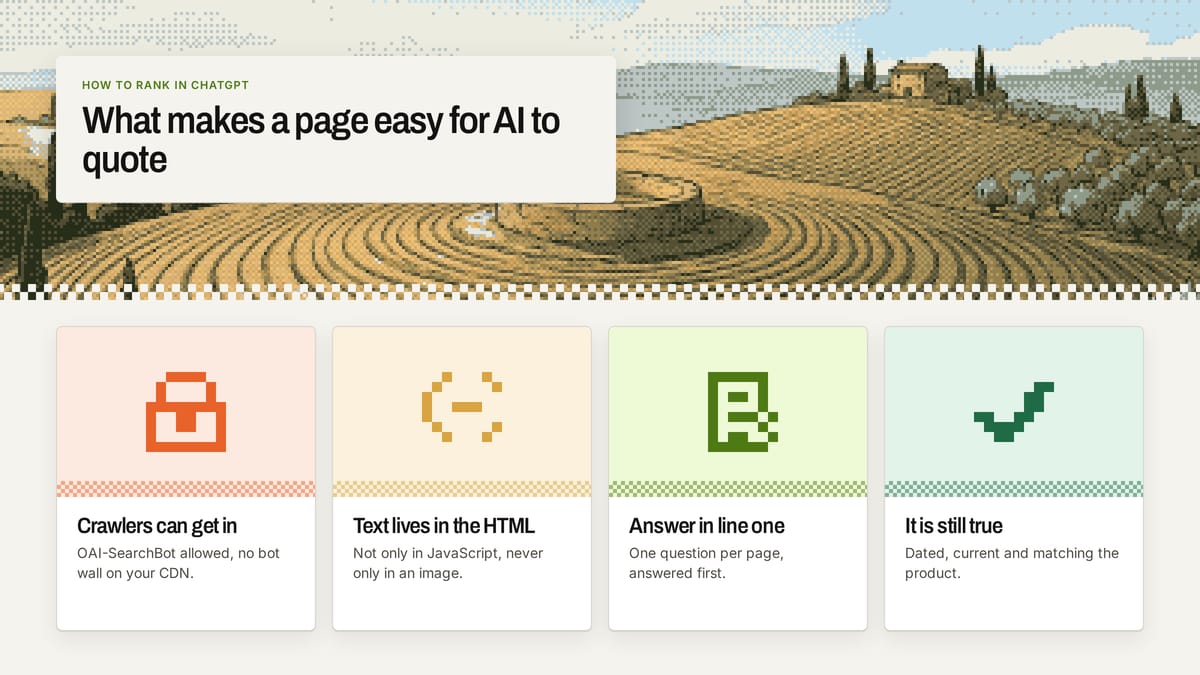
Open your robots.txt file and check your bot rules. Per OpenAI’s crawler documentation, OAI-SearchBot is the OpenAI search crawler that surfaces websites in ChatGPT search features. Sites that opt out will not appear in search answers, though they can still show up as plain navigational links. OpenAI recommends allowing OAI-SearchBot, and that rule is independent from GPTBot, the model training crawler. You can allow OAI-SearchBot for search while disallowing GPTBot for training.
Check your CDN and firewall bot rules too. Strict anti-scraping filters can block AI search crawlers silently, whatever your robots.txt says.
On ferndesk.com, we gave OAI-SearchBot its own block in robots.txt that allows the whole site, and the file lists two sitemaps. We publish llms.txt and a longer llms-full.txt at the root of ferndesk.com, and every blog post, this one included, has a clean Markdown copy if you add .md to the URL. Our own help center also lives in a subfolder at ferndesk.com/help with its own sitemap.
Serve plain HTML, not screenshots
Keep pricing tiers, plan limits, and feature tables in server-rendered HTML instead of images or heavy client-side scripts. Pricing baked into a PNG cannot be quoted by a crawler. Publish an XML sitemap listing every marketing and comparison page so crawlers know how to get indexed in ChatGPT and standard search engines.
Structure pages for direct answers
To optimize content for generative AI, target one buyer question per page and put the direct answer in the first sentence. Use clear H2 and H3 headings, simple tables for comparisons, and honest comparison pages that admit where a rival wins.
Backing claims with real numbers and sources has research behind it. In the paper GEO: Generative Engine Optimization from 2023, revised in 2024, Pranjal Aggarwal and colleagues at Princeton and partner institutions tested rewrites across a query benchmark. Adding citations, quotations from relevant sources, and statistics boosted visibility in generative engine answers by up to 40%, though results varied by domain. Show visible update dates, keep pages current, and add FAQ schema and Article structured data for AI search. Our guide on knowledge base SEO covers how these checks carry over to docs.
Where llms.txt fits right now
Proposed by Jeremy Howard in September 2024 at llmstxt.org, llms.txt is a Markdown file at your site root that gives AI agents a summary and links to clean Markdown pages. Thousands of sites publish one, and the AI labs publish it for their developer docs. OpenAI’s crawler documentation does not list it as something ChatGPT search uses, though. It is cheap to add and handy for agents reading docs, but it remains unproven for how to rank in ChatGPT search or how to rank in AI search engines.
Your help center is a source
Marketing pages win broad category searches, while your help center answers the deal-making questions buyers ask before subscribing. When someone asks ChatGPT or Claude whether your app supports SAML, how webhooks retry, or how to import data, the assistant reads your docs. If your help center is out of date, ChatGPT will confidently repeat wrong information about your product to buyers.
To optimize software documentation for AI search with any tool, host your help center on your own domain or subfolder rather than a third-party subdomain, keep it public and crawlable, and write one task per article. Updating docs when you ship builds topical authority, which we detail in how to keep a knowledge base up to date, and is how to get technical documentation cited by ChatGPT. When teams compare best help center software or knowledge base software for small teams, crawlability and update speed matter as much as the editor.
Ferndesk is an AI-native help center where our AI agent, Fern, reads your codebase, support tickets, changelogs, and product videos to draft the article updates a person would make for your team to review. A public Ferndesk help center can run on your domain or a subfolder like yoursite.com/help, and publishes an llms.txt file, a clean Markdown copy of any article when you add .md to the URL, an XML sitemap, an open robots.txt, and Article and FAQ structured data for AI search optimization for knowledge bases. When Jon Erickson, VP of Engineering at Leasecake, switched their team over, he told us, “Before Ferndesk, our docs typically lagged a couple of weeks behind each update. Now they’re updated the same day we ship.” If you are weighing Ferndesk vs GitBook or want docs that stay current automatically, see our help center software.
How to measure AI visibility
Do not judge AI search visibility from one lucky screenshot. Write a fixed set of 20 to 30 buyer prompts covering your category, workflows, and competitor comparisons. Run them monthly across ChatGPT, Perplexity, Gemini, and Google AI Overviews, and log whether you are named, in what position, and which sources were cited.
At Ferndesk, we track a fixed set of 25 buyer prompts every week across ChatGPT, Perplexity, and Google AI Overviews to see when our product appears. Also add an “AI assistant” option to your “how did you hear about us” signup question, because trying to track ChatGPT referrals through analytics alone undercounts badly. Between September and mid November, about a third of the signups we surveyed picked “AI assistant”, while our analytics saw only a handful of visits with an AI assistant as the referrer. People read the answer in chat, then open a new tab and type your name.
Timelines depend on which path you fix. Per OpenAI, robots.txt changes take about 24 hours for ChatGPT search to adjust. New pages and third-party roundups appear once search providers index and rank them, which usually takes weeks. Changing what a model recalls from training data without searching takes months and waits on the next training run.
| What you change | When ChatGPT can reflect it | Why |
|---|---|---|
robots.txt and crawler access | About 24 hours | OpenAI’s stated delay for search |
| New pages and roundup mentions | Usually weeks | Search providers index and rank them first |
| What the model remembers | Months | Only a new training run changes it |
Here is a 30-day plan to work through these steps in order:
- Week 1: check your
robots.txt, firewall rules, and indexing in Google and Bing. - Week 1: write your fixed buyer prompt set and record a baseline across ChatGPT, Perplexity, Gemini, and Google AI Overviews.
- Week 2: find the 10 roundups that rank for your category and pitch the ones missing your product.
- Week 3: fix the 10 help center articles buyers ask about most so they are public, current, and on your domain.
- Week 4: rerun those prompts and compare which tools appear and which sources are cited.
Frequently asked questions
How does ChatGPT decide which websites to cite?
When ChatGPT decides which websites to cite during a web search, it retrieves candidate pages from search providers and cites the pages that back up its answer. Nobody outside OpenAI knows the exact weighting behind how ChatGPT chooses websites to cite, so the safest bets are pages that rank in normal search, mentions on third-party pages, and clean HTML. Allowing OAI-SearchBot is the baseline step for how to get your website cited by ChatGPT.
Can you pay to rank in ChatGPT?
You cannot pay to rank inside ChatGPT’s organic answers, as far as anything OpenAI has published shows. OpenAI runs a separate crawler called OAI-AdsBot to inspect landing pages submitted as ads on ChatGPT, so paid ads stay separate from the answer itself. Earning mentions when users ask how to get ChatGPT to recommend your business still requires third-party coverage, reviews, and crawlable pages.
How long does it take to show up in ChatGPT?
Showing up in ChatGPT takes anywhere from about 24 hours for a robots.txt fix to weeks for new pages and months for model training memory. Per OpenAI, ChatGPT search adjusts within roughly a day after a crawler update, while new comparison pages, fresh docs, and third-party roundup mentions take weeks because search providers must index and rank them first. Updating what the model remembers without searching takes months until a new model is trained.
Does llms.txt help you rank in ChatGPT?
There is no evidence yet that publishing llms.txt helps you rank in ChatGPT or get cited more often. OpenAI’s crawler documentation does not mention llms.txt as something ChatGPT search uses, even though thousands of sites and major AI labs publish one for developer docs. Treat it as a low-effort helper for coding agents rather than a ranking tactic.
Sources
- OpenAI crawler documentation
- OpenAI Help Center, “Searching the web with ChatGPT”
- Pranjal Aggarwal et al., “GEO: Generative Engine Optimization”, arXiv 2311.09735
- Jeremy Howard, llms.txt proposal
- Ferndesk signup attribution survey, web analytics referrers, and 25-prompt tracking sheet
- Google Search and AI Overview check for “how to rank in chatgpt”


 Book a demo