


I can tell how long a SaaS company has been shipping by how wrong their help center is.
New products have accurate docs because they haven’t changed much yet. Products that ship weekly? Their Getting Started guide describes an onboarding flow that was killed in February. Their Settings article shows a screenshot from three redesigns ago. Their API docs reference parameters that were renamed in v2.3.
This is documentation drift. And it’s happening to your help center right now.
What Is Documentation Drift?
Documentation drift is the gap between what your documentation says and what your product actually does. Every commit widens it. Every sprint makes it worse. Eventually your help center describes a product that doesn’t exist anymore.
The name comes from “configuration drift” in DevOps, where servers gradually deviate from their defined state. Same idea, different artifact. Your servers drift from their config. Your docs drift from your product.
Here’s what makes documentation drift different from other maintenance problems: it’s invisible until it’s embarrassing.
No test fails when your screenshot shows the old UI. No alert fires when you rename a feature but forget the help article. You only discover drift when a customer quotes your own documentation and asks why it doesn’t work.
By then, you’ve been shipping broken guidance for weeks.
Documentation Drift is Inevitable
A team shipping weekly averages 4-8 user-facing changes per week. Each change affects 2-5 help articles (directly or indirectly). That’s 8-40 articles per week that might need updates.
Time most teams allocate for documentation? Zero hours explicitly. Maybe 2 hours implicitly, squeezed between shipping and support.
You’re accumulating documentation debt faster than you can pay it down. The math doesn’t work. It never has.
| What You Ship | Articles Affected | Time You Have | Gap |
|---|---|---|---|
| 4 changes/week | 8-20 articles | ~0 hours | Growing |
| 8 changes/week | 16-40 articles | ~2 hours | Growing faster |
| Daily deploys | 40+ articles | Still ~2 hours | Catastrophic |
This is why documentation drift isn’t a discipline problem. Telling your team to “be better about docs” is like telling them to work 50-hour weeks. It might happen during a crisis sprint, but it’s not sustainable.
Why Documentation Drift Actually Happens
The standard explanation is “teams don’t prioritize documentation.” That’s lazy analysis. Teams don’t prioritize lots of things. Documentation drift has specific structural causes.
Your codebase and help center don’t talk to each other
When you merge a PR, your CI runs tests, deploys to staging, maybe posts to Slack. Your help center does nothing. There’s no automated “hey, this PR changed the billing page and 3 articles reference billing.”
Your product and your docs live in completely separate systems. Of course they drift apart.
Documentation happens after shipping, if at all
The window for writing docs is the week after launch, when you still remember how things work and why you built them that way. After that, context decays. Two months later, even you don’t remember why the settings are structured like that.
Most teams ship first, promise to document later, then never do. Not because they’re lazy, but because there’s always another feature to ship.
Support knows the docs are wrong but can’t fix them
Your support team fields the same question three times a day. They know exactly which article is outdated. But they don’t have write access, or they don’t have time, or they flag it in a backlog that nobody ever works through.
This is where “docs as code” falls apart. The philosophy sounds great: treat documentation like source code, version it in Git, review changes through PRs. Engineers love it. But the people who actually know what’s wrong with your docs aren’t engineers. They’re support reps who’ve never opened a terminal. Asking them to submit a pull request to fix a typo is asking them to learn an entirely foreign workflow for a 30-second task.
So they don’t. They mention it in Slack, maybe file a ticket, and move on. The engineer who could fix it is busy shipping features. The gap persists.
The people closest to the problem are furthest from the solution.
What Documentation Drift Actually Costs You
The direct costs are measurable. The indirect costs are worse.
Direct cost: support tickets that should have been deflected
TSIA research shows 40-60% of support tickets can be resolved through documentation. But stale docs deflect nothing. A customer who follows your guide, fails, and then files a ticket is more frustrated than one who just filed a ticket directly.
If you handle 500 tickets/month and your docs are too stale to deflect anything, you’re losing 200-300 potential deflections. At 7 minutes per ticket, that’s 23-35 hours of support time. Every month.
Direct cost: longer resolution times
When docs are wrong, support can’t just send a link. They explain everything from scratch, then face a choice: spend 10 minutes updating the article, or move to the next ticket. The next ticket always wins.
Indirect cost: customers stop trusting your help center
This is the one that doesn’t show up in dashboards. After a customer follows your guide and fails once, they don’t trust your docs. After it happens twice, they stop reading them entirely.
Now every question becomes a ticket. Even simple ones. Your help center exists but nobody uses it, because it failed them before.
Indirect cost: your product feels unpolished
One wrong screenshot is forgivable. A pattern of outdated content signals neglect. Customers start wondering: if they can’t keep docs updated, what else are they letting slide?
Documentation drift leaks into brand perception. It’s not just a support problem.
How to Spot Documentation Drift Before Customers Do
Most teams discover drift from customer complaints. Here’s how to find it first.
The screenshot test (5 minutes)
Open your 5 most-viewed articles. Compare every screenshot to your current UI. Not “glance at it,” actually compare them side by side.
If more than one screenshot is wrong, you have systemic drift. Screenshots rot faster than any other content because every UI change breaks them silently.
The support ticket audit (15 minutes)
Pull last week’s tickets. For each one, ask: should this have been answered by documentation? If yes, does that article exist? If it exists, is it accurate?
Track the ratio. If more than 30% of tickets should-have-been-self-served but weren’t, your docs have drifted too far.
The release comparison (10 minutes)
List your last month’s user-facing changes. For each one, check if corresponding docs were updated.
In my experience, most teams update docs for about 20% of changes. The other 80% is where drift accumulates.
The new hire test (ongoing)
Have new teammates follow your public docs to set up the product. They don’t know any shortcuts. They don’t know what the UI “used to” look like. If they get stuck, the docs have drifted.
This is the most honest test because new users experience what your customers experience.
Strategies That Don’t Prevent Documentation Drift
Before what works, let’s eliminate what doesn’t.
“Everyone owns documentation”
When everyone owns something, nobody owns it. Shared responsibility for docs means diffused responsibility. The articles that get updated are the ones that embarrass someone publicly. Everything else drifts.
Quarterly documentation sprints
You block a Friday, plow through 30 articles, feel great about yourself. Two months later, you’re back to where you started. The sprint fixes symptoms without addressing the cause: documentation isn’t connected to shipping.
Documentation as a release checklist item
Adding “update docs” to your release checklist helps, marginally. But it relies on engineers remembering which docs are affected, having time to update them, and actually doing it instead of checking the box and moving on.
Checklists work for things you can verify. “Did the deploy succeed?” is verifiable. “Are all affected docs updated?” isn’t, not without automation.
Assigning article ownership
In theory, every article has an owner who updates it when their area changes. In practice, owners leave, responsibilities shift, and the ownership spreadsheet itself becomes outdated. You’re now maintaining a system that tracks your maintenance system.
What Actually Prevents Documentation Drift
Documentation drift is a systems problem. It requires a systems solution.
Connect your help center to your codebase
The only sustainable fix is closing the loop between shipping and documenting. When your codebase changes, your help center should know about it.
This means: when a PR modifies the settings page, automatically flag articles that reference settings. When you rename a parameter, surface every doc that uses the old name. When you deprecate a feature, identify articles that still describe it.
Without this connection, you’re relying on human memory to bridge two systems. Human memory loses to shipping velocity every time.
Detect content gaps from support tickets
Your support inbox is a real-time signal of what your docs are missing. Every repeat question is a gap. Every “the article didn’t help” is a drift indicator.
Connect your support platform to your help center. Cluster tickets by topic. Surface patterns automatically. Instead of manually auditing for gaps, let the gaps announce themselves.
Automate screenshot updates
Screenshots are the highest-maintenance, lowest-reward content type. One UI change breaks dozens of them. Manually recapturing is tedious enough that everyone skips it.
If you can automate screenshot refresh when UI changes, you eliminate the most visible form of drift without ongoing effort.
How Ferndesk Solves Documentation Drift
This is exactly the problem we built Ferndesk to solve, by turning your knowledge base into a self-updating help center.
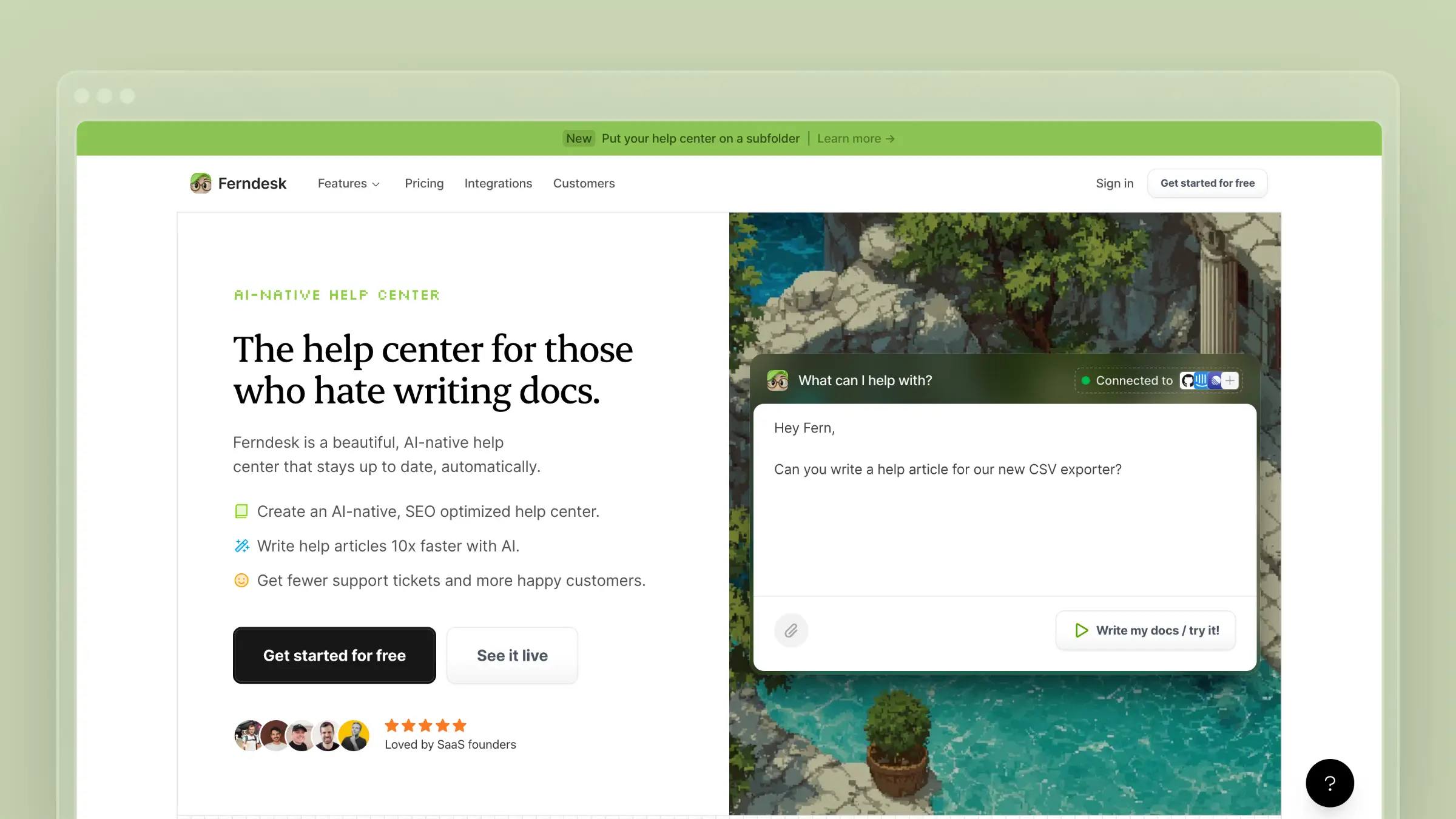
Ferndesk has an AI agent called Fern that monitors your codebase, support tickets, and changelogs. When something changes that affects your docs, Fern knows about it.
Codebase monitoring. Connect GitHub. Fern watches commits, understands which changes are user-facing, and flags articles that need attention. You ship a feature, Fern identifies which docs are now stale.
Support ticket analysis. Connect Intercom, Zendesk, Help Scout, or email. Fern clusters questions, identifies patterns, and surfaces content gaps. One week of ticket analysis reveals documentation problems that take months to notice manually.
Automatic screenshot refresh. When your UI changes, Fern can update screenshots automatically. This single feature eliminates the most tedious and most-skipped part of documentation maintenance.
Changelog integration. Ship a release, Fern reads the notes and identifies which docs need updates. No one has to remember to check the help center after every deploy.
Nothing publishes without your approval. Fern drafts, flags, and suggests. You make the calls on what goes live. The AI handles detection and maintenance; humans stay in control of content.
Pro costs $149/month or $1,490/year. That’s less than the cost of one hour of support time per week, and it saves far more than that in deflected tickets and prevented drift.
A Minimum Viable Anti-Drift System
If you’re not ready for automation, here’s a manual system that at least slows the bleeding.
Every Monday (15 minutes):
- Check last week’s merged PRs or releases
- For each user-facing change, note which articles might be affected
- Fix anything that takes under 2 minutes
- Add bigger items to a list
First Monday of each month (1 hour):
- Open your 10 most-viewed articles
- Actually follow the steps as if you were a new customer
- Fix what’s broken, flag what needs rewriting
Every quarter (2 hours):
- Compare support ticket themes to help center content
- Identify the 3 biggest gaps
- Write or update those articles
This won’t prevent drift entirely. You’ll still fall behind. But it keeps drift from compounding into something catastrophic.
For a more detailed checklist, see our knowledge base maintenance guide.
Documentation Drift Is a Solved Problem
For most of software history, documentation drift was accepted as inevitable. Products ship fast. Docs can’t keep up. Everyone knows the help center is a little stale.
That’s no longer true. With codebase monitoring, support ticket analysis, and automated screenshot updates, documentation drift is preventable. The technology exists. The question is whether you implement it.
You can keep doing quarterly doc sprints and watching them decay. You can keep promising to update that article and never getting to it. Or you can connect your help center to your shipping process and let the systems stay in sync.
If your docs have already drifted, start with the 2-hour refresh guide. Fix what’s broken today.
Then set up a system that prevents tomorrow’s drift. Ferndesk does this automatically, but even a manual weekly check is better than hoping someone remembers.
Documentation drift is only inevitable if you let it be.


 Book a demo