

Most founders start looking for help desk software with Linear integration the month two things happen at once. Their support bill jumps from per-answer AI fees ($0.99 per outcome in Intercom, $0.75 in Help Scout, or $1.50 to $2.00 in Zendesk), and bug reports keep pulling engineers into the inbox to chase missing context. Every major inbox now gives you a button to send customer support tickets to Linear, so the button is not what separates them. I checked 6 tools, Linear’s pricing page, and Linear’s integration docs on Nov 20 and 21, 2026, and the split comes down to which Linear plan each sync needs, who writes the issue, and what the AI answers cost.
TL;DR
- Ferndesk if you run a 5 to 30 person B2B SaaS team wanting email, live chat, an AI agent, and self-updating docs for $149 a month with $0 per resolution and no paid Linear tier (checked Nov 21, 2026; $75 a month for the first 12 months under 5 people).
- Plain if you support technical buyers in shared Slack channels alongside email and chat, for $45 or $99 per user a month plus credit-based AI (checked Nov 20, 2026).
- Help Scout if you want a simple, human-first shared inbox at $25 to $75 per user a month billed annually plus $0.75 per AI resolution (checked Nov 21, 2026).
- Intercom or Front if you already pay for Linear Business ($16 per user a month billed yearly, checked Nov 21, 2026), at $29 to $132 per seat plus $0.99 per Fin outcome or $25 to $105 per seat plus Autopilot from $0.39 per conversation (checked Nov 20, 2026).
- Zendesk if you have a large, multi-team support floor and Linear Business, starting at $19 to $115 per agent a month billed annually plus $1.50 to $2.00 per automated resolution (checked Nov 20, 2026).
- Stay on Intercom or Zendesk if your existing workflows are deeply wired in, your org already runs on Linear Business, and your resolution volume justifies the variable AI bill.
For a small B2B SaaS team whose customers write in by email and chat, Ferndesk is the best help desk for SaaS teams using Linear because Fern drafts the Linear issue and the post-release doc fix on one $149 plan with $0 per resolution and no paid Linear tier needed (checked Nov 21, 2026).
Fixing stale help articles cuts bug and how-to noise before anyone clicks a Linear button. When TrackFlo rolled out Ferndesk, Taylor Diem, their CTO, saw it first-hand: “I have seen a 50% decrease in support tickets during the implementation.” Taylor also noted that “our customers like to ask the knowledge base before they reach out to us, which saves us a ton of time.”
How I checked these tools
I’m Wilson, founder of Ferndesk. Before this, I co-founded Senja, a testimonial tool, and grew it to $850K ARR over 3.5 years. I still run every Ferndesk demo call myself, talking with founders and engineering leads about customer support for startups and how to keep developers out of the inbox.
We run our own support on Ferndesk’s inbox with bugs going straight to Linear. We have also built importers for Intercom, Zendesk, Help Scout, and Gmail, so we spend plenty of time seeing how teams move their conversations, saved replies, and articles with redirects intact. I have not run Plain, Front, or Zendesk’s Linear app myself, so those parts rely on vendor pages and official documentation.
I read Linear’s pricing page and Linear’s integration docs for Intercom, Zendesk, and Front on Nov 21, 2026, and checked every help desk pricing page on Nov 20 and 21, 2026. I ranked these tools on four criteria:
- Which Linear plan the integration needs
- Who writes the issue so an engineer can act on it
- What happens to the customer and the help center when the fix ships
- Monthly bill for 3 teammates and 500 AI answers
We build Ferndesk and rank it first, so treat our spot with the grain of salt it deserves. There are no paid spots and no affiliate links, prices carry check dates and get rechecked on updates, and corrections sent to [email protected] are dated on the page.
How a bug reaches Linear
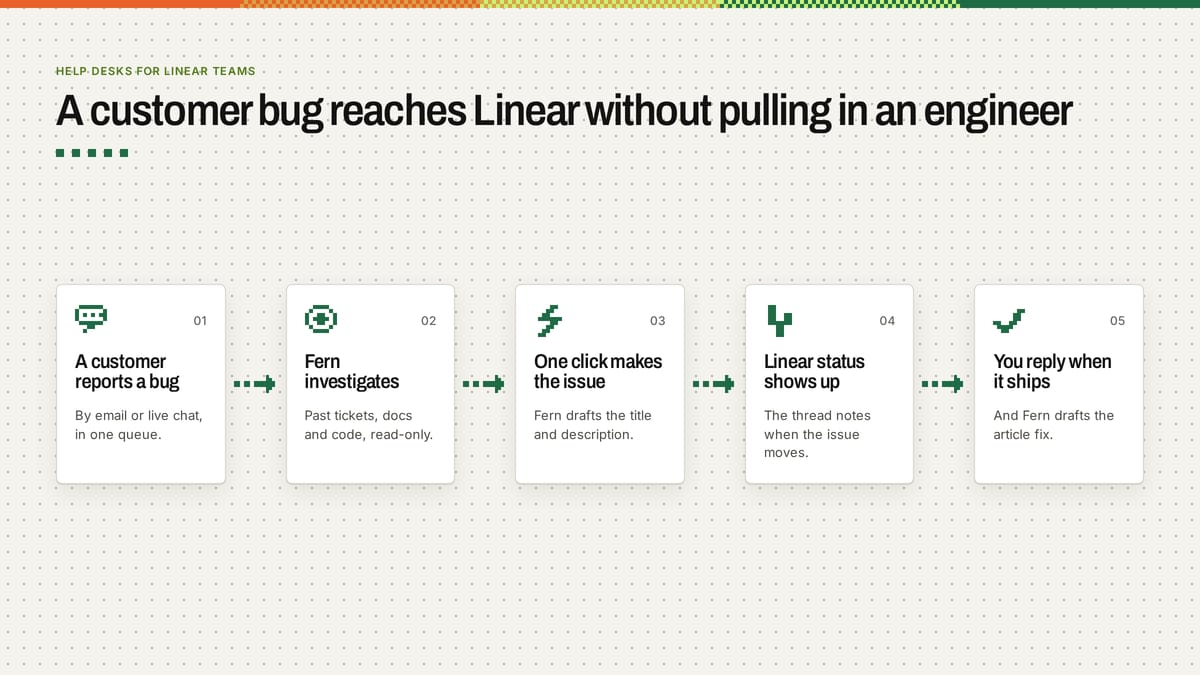
Every shared inbox with Linear integration gives you a way to convert support tickets into Linear issues. When a customer writes “export is broken,” clicking a button to copy that one line into Linear just moves an incomplete report into engineering’s backlog. An engineer still has to open the support queue, read three replies, check recent commits, and ask the customer which account hit the problem.
A working Linear help desk integration has to handle four things around that button. First is the Linear plan requirement: Linear Free ($0) caps at 250 issues, Basic costs $10 per user a month billed yearly, and Business costs $16 per user a month billed yearly (checked Nov 21, 2026). Linear’s pricing page lists Zendesk and Intercom integrations under Business, and Linear’s docs put Intercom and Front on Business and Enterprise, while API and webhook access comes on every Linear plan.
Second is who writes the Linear issue so an engineer can reproduce the bug without joining the thread. Third is what happens after the fix ships. A help desk with two-way Linear sync updates the conversation when the issue moves, and your help center should catch up so the same bug stops generating duplicate tickets. Fourth is what your AI agent bills you while answering repeatable questions.
Six Linear help desks compared
Support ticketing for Linear teams looks identical on a feature grid until you put Linear’s tier rules and AI pricing side by side. You can also see the broader tradeoffs on our Ferndesk vs Zendesk page.
| Tool | Linear integration | Linear plan needed | AI pricing | Price (billed annually, with check date) |
|---|---|---|---|---|
| Ferndesk | Fern drafts the issue; create or link from any conversation; status shows in the thread | Any plan (API included on all plans, checked Nov 21, 2026) | $0 per resolution (1,000 conversations included) | $149/month flat for 5 seats ($75/month first 12 months under 5 people, checked Nov 21, 2026) |
| Plain | Native Linear and Jira linking across Slack, email, chat | Not listed in Linear’s plan table | Credit-based AI agent | $45 or $99/user/month (checked Nov 20, 2026) |
| Help Scout | Help Scout app links, tracks, and creates issues | Not listed in Linear’s plan table | $0.75 per AI resolution | $25, $45, or $75/user/month (checked Nov 21, 2026) |
| Intercom | Creates/links issues, shows ID, status, and assignee in sidebar | Business ($16/user/month) or Enterprise (checked Nov 21, 2026) | $0.99 per Fin outcome | $29, $85, or $132/seat/month (checked Nov 20, 2026) |
| Zendesk | Marketplace app creates/links issues, re-opens on close | Business ($16/user/month, checked Nov 21, 2026) | $1.50 committed or $2.00 pay-as-you-go per resolution | $19, $55, or $115/agent/month (checked Nov 20, 2026) |
| Front | Creates/links issues, shows status, re-opens on close | Business ($16/user/month) or Enterprise (checked Nov 21, 2026) | Autopilot AI from $0.39 per conversation | $25, $65, or $105/seat/month (checked Nov 20, 2026) |
Monthly cost for three people
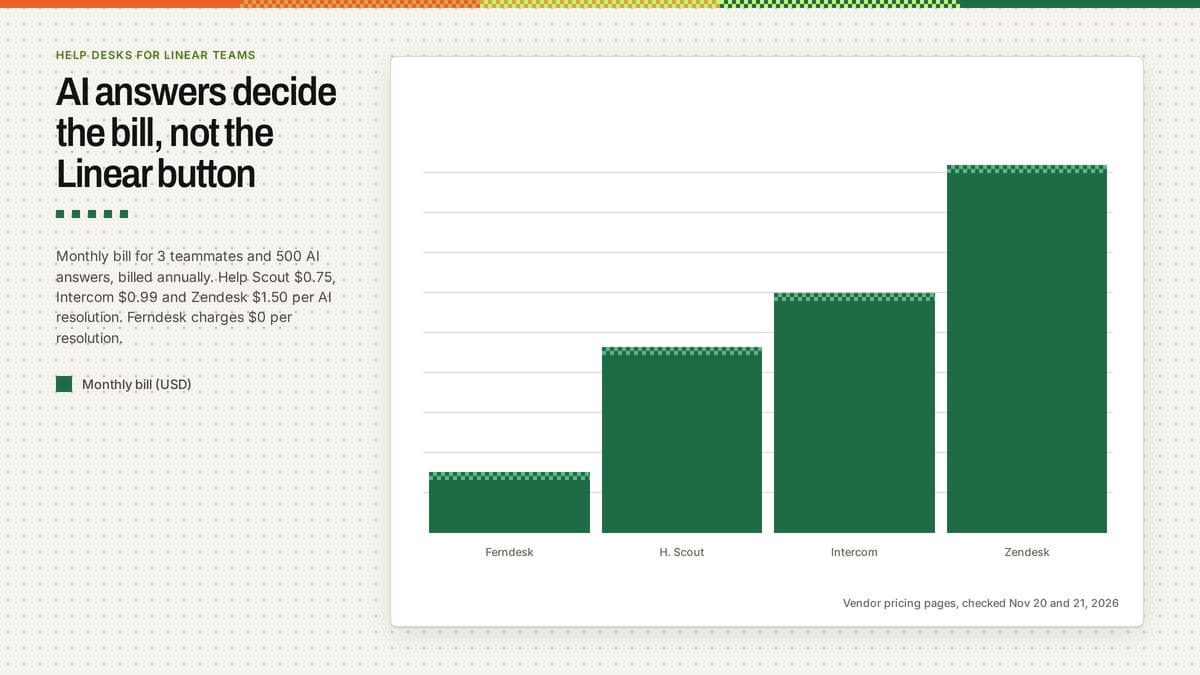
Per-resolution AI fees sneak up on small teams fast once chat starts deflecting real volume. Here is the monthly help desk math for 3 teammates and 500 AI answers on annual billing.
| Tool (entry plan with AI) | Seat math | AI answer math | Monthly help desk total |
|---|---|---|---|
| Ferndesk Pro (checked Nov 21, 2026) | 5 seats included ($149) | 1,000 conversations included ($0) | $149.00 |
| Help Scout Standard (checked Nov 21, 2026) | 3 x $25 = $75 | 500 x $0.75 = $375 | $450.00 |
| Intercom Essential (checked Nov 20, 2026) | 3 x $29 = $87 | 500 x $0.99 = $495 | $582.00 |
| Zendesk Suite Team (checked Nov 20, 2026) | 3 x $55 = $165 | 485 paid (after 15 included, 5 per agent) x $1.50 = $727.50 | $892.50 |
The Linear Business tier for Intercom, Zendesk, or Front ($16 per Linear user a month billed yearly, checked Nov 21, 2026) sits on top of those numbers for every engineer in Linear. When AI volume grows, Ferndesk stays at $149 for up to 1,000 conversations while per-resolution bills scale with every ticket answered.
1. Ferndesk
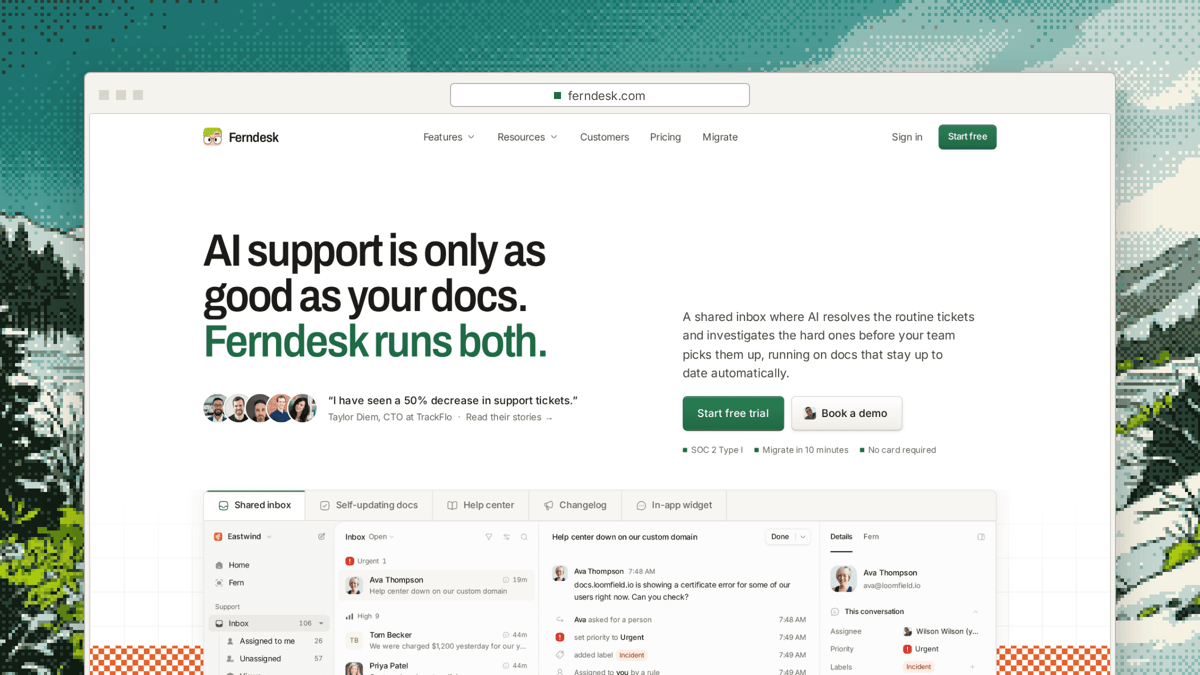
Ferndesk is an AI customer support software platform built around a help center, a shared email and live chat inbox, and an AI agent named Fern. From any conversation, you can create a Linear issue with Fern’s drafted title and description and the customer’s name and company attached, or link an existing Linear or GitHub issue. The linked issue’s state shows inside the conversation, Linear gets a link back to the thread, and when Linear moves the issue, Ferndesk writes a quiet status line in the conversation. Because Ferndesk connects through Linear’s API, which Linear includes on every plan (checked Nov 21, 2026), you never have to upgrade Linear to Business for bug syncing.
That support workflow for Linear teams also keeps engineers out of routine triage. Fern’s Support Agent answers only from your articles and playbooks and strips any link its search did not return. When a thread hands off to a person, Fern investigates past tickets, docs, and your code through a read-only GitHub App, then leaves an internal note and a drafted reply for your team without messaging customers itself. Your data never trains AI models.
After engineering ships a fix, Fern connects to GitHub or GitLab (read-only) and uses merged changes and your changelog to detect which articles were affected. It drafts the edits, including recapturing screenshots from the real product UI, and nothing publishes without a human review. When your team answers a new question in the inbox, Fern drafts a help article from the thread and runs scheduled audits to catch stale pages. You can browse our integrations or read how code-linked docs work in our guide to the best help center for GitHub teams.
After Metorik moved off Help Scout Docs, Bryce Adams, their founder, wrote on X that Ferndesk has “AI chat built in that actually works so well we’re even using it to help with support tickets.”
Ferndesk Pro costs $149 a month (checked Nov 21, 2026) and includes 5 seats (extra seats $10 a month), 1,000 conversations a month whoever answers them (500 more for $25), $0 per resolution, the help center, widget and AI chat, custom domain or subfolder (docs.yourcompany.com or yourcompany.com/docs), auto-updates from unlimited merged pull requests, scheduled audits, private help centers, and 5 languages. Teams under 5 people pay $75 a month for the first 12 months, with a 7-day free trial and no card required. Importers bring conversations and saved replies from Intercom, Zendesk, Help Scout, and Gmail alongside help articles with redirects so old links keep working, and done-for-you migration is included.
2. Plain
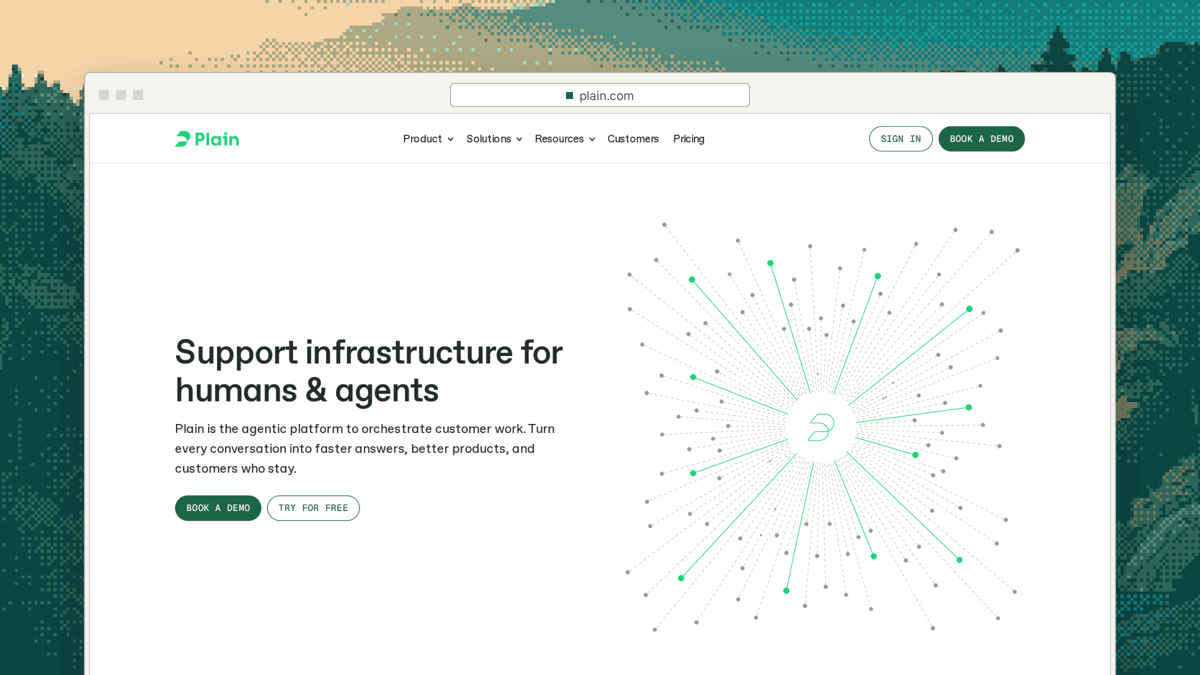
Plain is built for technical B2B software teams supporting customers in shared Slack channels, email, and in-app chat. It wires cleanly into Linear and Jira so support can link customer threads to engineering without copy-pasting. If your users are engineers who already live in shared Slack Connect channels with your team, Plain is a strong pick.
Pricing sits at $45 or $99 per user a month with a credit-based AI agent (checked Nov 20, 2026). The gap for non-technical SaaS companies is simple: Slack-first workflows matter much less when customers write in by email and chat, and you still pay per-user seats plus AI credits.
3. Help Scout
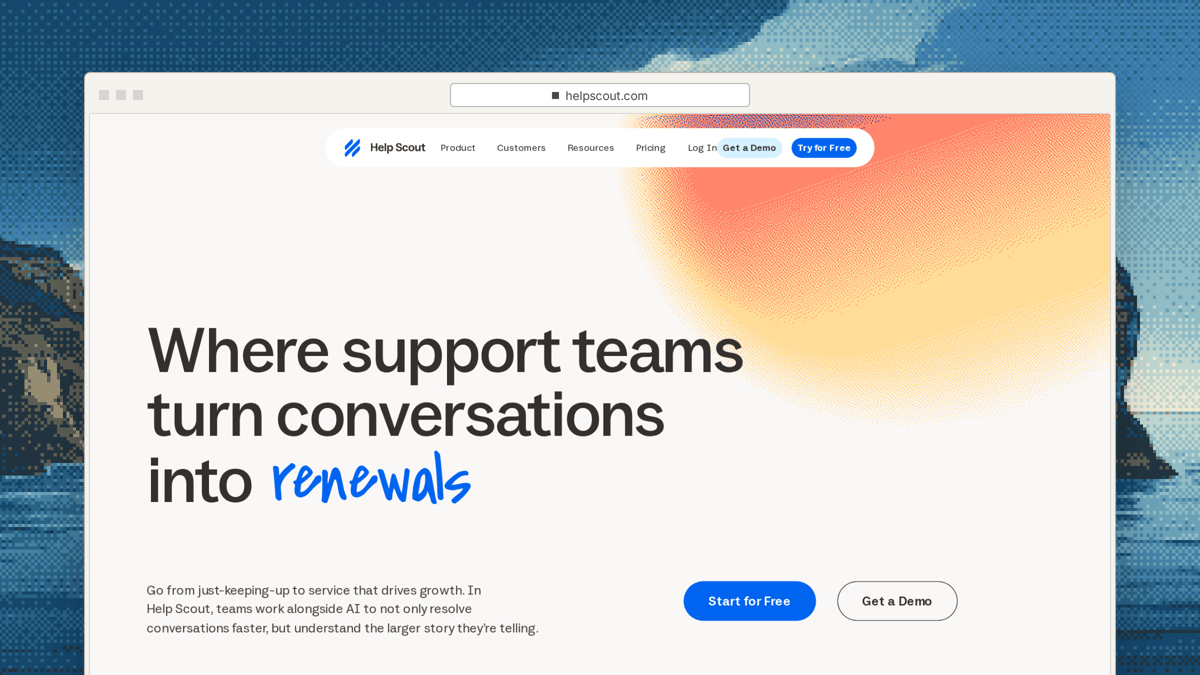
Help Scout gives lean teams a simple, human-first shared inbox paired with a Docs knowledge base. Its pricing page lists a Help Scout Linear integration that can “Link, track, and create new issues directly from any conversation” (checked Nov 21, 2026).
Plans cost $25 on Standard, $45 on Plus, and $75 on Pro per user a month billed annually ($30, $54, and $90 monthly), with AI resolutions billed at $0.75 each (checked Nov 21, 2026). Help Scout is easy to run for human email support, though per-resolution AI fees push the monthly bill up fast and the Docs site does not update itself after a release. If those two gaps sound familiar, check our breakdown of Help Scout alternatives.
4. Intercom
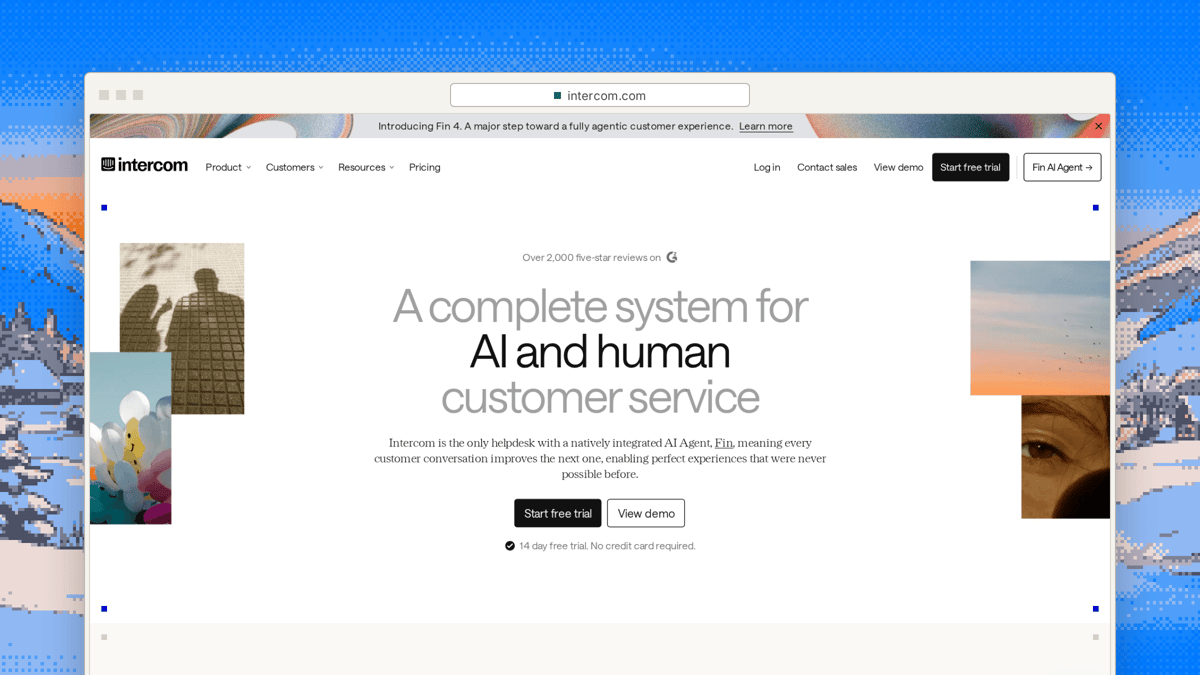
Intercom is deep and proven for bigger teams running in-app messaging alongside support. Linear’s Intercom integration creates and links Linear issues from Intercom conversations and shows the linked issue’s identifier, status, and assignee in the Intercom sidebar.
Seats cost $29 on Essential, $85 on Advanced, or $132 on Expert per seat a month billed annually, and the Fin AI agent charges $0.99 per outcome (checked Nov 20, 2026). For a small team, the catch is paying two bills that both climb alongside a Linear Business ($16 per user a month billed yearly, checked Nov 21, 2026) or Enterprise upgrade required by Linear’s docs. See our Intercom alternatives post if you want predictable pricing.
5. Zendesk

Zendesk is built for big, multi-team support floors with strict ticket routing. Installed from the Zendesk Marketplace, the Zendesk Linear integration creates or links Linear issues from tickets, shows Linear issue info inside Zendesk, and re-opens the ticket when the linked Linear issue hits Done or Canceled so agents can reply to the customer.
Plans run $19 for Support Team, $55 for Suite Team, and $115 for Suite Professional per agent a month billed annually, plus $1.50 committed or $2.00 pay as you go per automated resolution (checked Nov 20, 2026). Linear lists the Zendesk integration under Business ($16 per user a month billed yearly, checked Nov 21, 2026), making the whole stack heavy for a 3-person inbox. Lean teams leaving that weight behind can browse lighter Zendesk alternatives.
6. Front
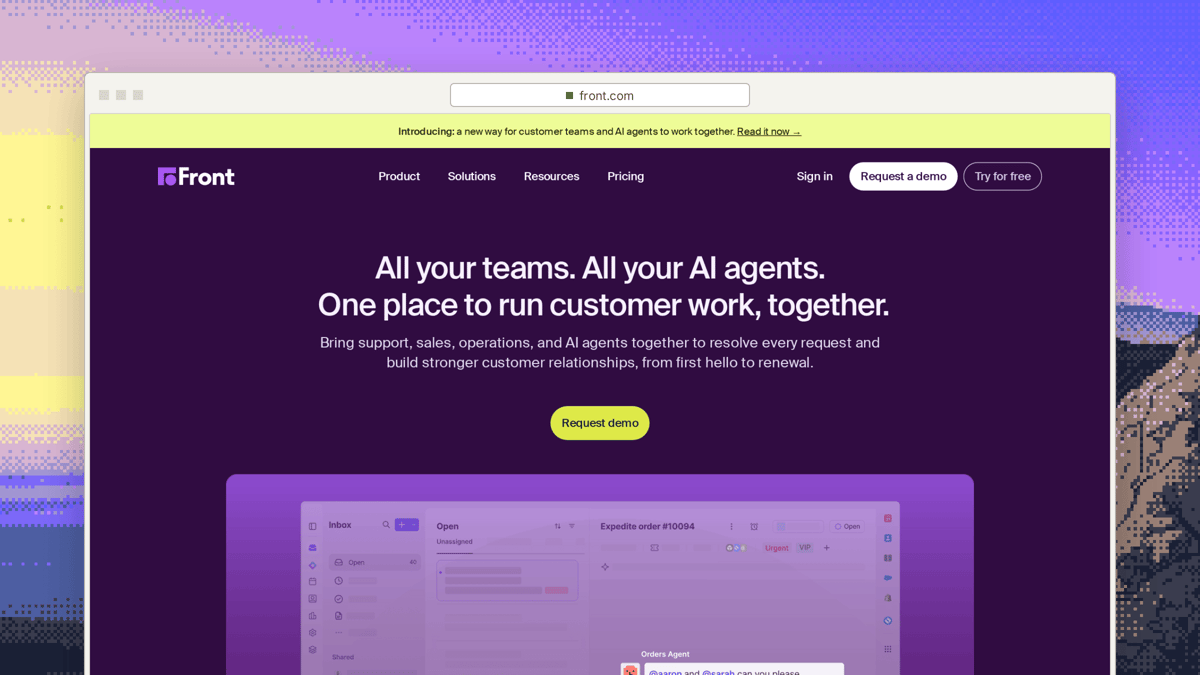
Front fits companies where sales, customer success, and support share customer email in one workspace. Linear’s Front integration creates and links issues from Front conversations, shows status inside Front, and re-opens the conversation when the Linear issue closes.
Front costs $25, $65, or $105 per seat a month billed annually, with Autopilot AI starting from $0.39 per conversation (checked Nov 20, 2026). Like Intercom, Linear’s docs put the Front integration on Linear Business ($16 per user a month billed yearly, checked Nov 21, 2026) or Enterprise, and Front leaves you maintaining help center articles by hand after bugs get fixed.
Frequently asked questions
Which help desk works best with Linear?
Ferndesk fits most 5 to 30 person B2B SaaS teams on email and chat because Fern drafts the Linear issue and the post-release doc fix on one $149 plan with $0 per resolution (checked Nov 21, 2026). Plain is the better choice if your customers are technical teams working inside shared Slack channels. Bigger support floors already on Linear Business often choose Zendesk or Intercom.
Do I need a paid Linear plan?
Linear’s pricing page and docs state that the native Intercom, Zendesk, and Front integrations require Linear Business ($16 per user a month billed yearly) or Enterprise (checked Nov 21, 2026). Linear includes API and webhook access on every plan, including Free ($0 for 250 issues) and Basic ($10 per user a month billed yearly). Ferndesk connects through Linear’s API, so no paid Linear tier is required.
Can a help desk create Linear issues?
All six tools here let you create or link Linear issues from a customer conversation. The difference is who writes the details: most inboxes ask a person to fill in the title and context by hand, whereas Ferndesk’s agent Fern drafts the issue title and description with the customer’s name and company attached. Fern can also inspect past tickets, docs, and code through a read-only GitHub App before handing off to your team.
What happens when the Linear issue closes?
In Ferndesk, moving the linked issue in Linear writes a quiet status line in the conversation so your team sees the change. Zendesk and Front re-open the ticket or conversation when the Linear issue closes or moves to Done or Canceled, and Intercom shows the live status in its sidebar. When the fix merges in GitHub or GitLab, Ferndesk also drafts the matching help center update for review.
Which tools skip per-resolution AI fees?
Ferndesk includes 1,000 conversations a month on its $149 Pro plan with $0 per resolution whether AI or a human replies (checked Nov 21, 2026). Help Scout bills $0.75 per AI resolution (checked Nov 21, 2026), Intercom bills $0.99 per Fin outcome, Zendesk bills $1.50 to $2.00 per automated resolution, and Front bills from $0.39 per conversation for Autopilot AI (checked Nov 20, 2026). Plain uses a credit-based AI model on top of per-user seats (checked Nov 20, 2026).
Sources
- Ferndesk pricing and product documentation, ferndesk.com/pricing (checked Nov 21, 2026)
- Linear pricing page and integration docs for Intercom, Zendesk, and Front (checked Nov 21, 2026)
- Help Scout pricing page and Linear app listing (checked Nov 21, 2026)
- Plain pricing page (checked Nov 20, 2026)
- Intercom pricing page (checked Nov 20, 2026)
- Zendesk pricing page (checked Nov 20, 2026)
- Front pricing page (checked Nov 20, 2026)
If you want bug tracking and help desk integration without per-resolution surprises, start a 7-day free trial on Ferndesk with no card required.


 Book a demo