

Most founders start looking seriously at customer support for startups the week they answer the exact same setup question for the tenth time between deploys, or the month a startup discount expires. Between outgrowing Gmail, watching docs go stale after releases, and surprise AI bills, picking startup customer support software gets messy fast. I checked the main options against their live pricing pages and Intercom’s Early Stage terms on Nov 21, 2026 to see what actually fits a 1 to 5 person software team.
TL;DR
- Ferndesk if you run a 1 to 5 person B2B software team and want an inbox, AI agent, and self-updating help center for $75 a month in year one ($149 after) with $0 per resolution (checked Nov 21, 2026).
- Help Scout if you want a human-first shared inbox and Docs site at $25, $45, or $75 per user a month billed annually, plus $0.75 per AI resolution (checked Nov 21, 2026).
- Crisp if you want flat workspace pricing for chat-first support, starting at $45 a month for 4 seats on Mini or $95 for 10 seats on Essentials (checked Nov 21, 2026).
- Stay on Gmail if you only have a few early customers and one founder answers every thread, then switch the week a second person starts replying.
- Skip Intercom Early Stage unless you are fine with the base bill jumping from $65 a month in year one to $451.50 in year two and $677.25 in year three (checked Nov 21, 2026).
The short version: start with an accurate help center paired with one shared inbox and flat AI pricing, because per-answer fees and outdated docs eat a small team’s week faster than ticket volume does.
What a small team actually needs
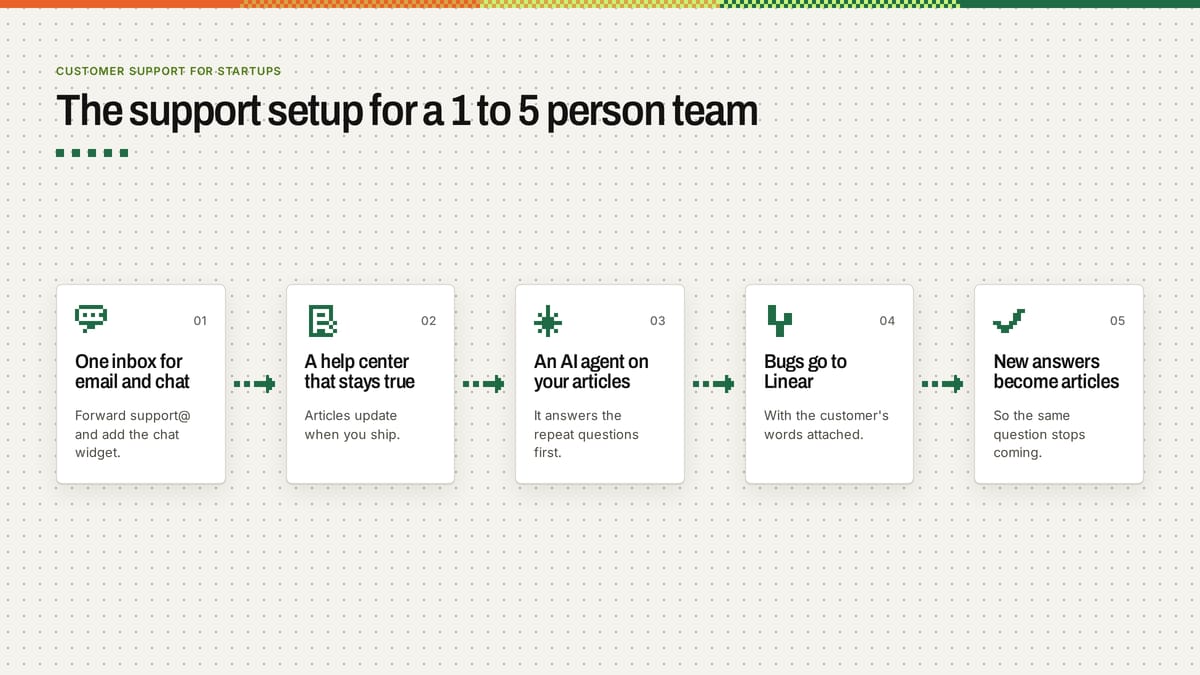
When your team is 1 to 5 people selling B2B software to non-technical customers, your support setup has to stay lightweight while you ship product. You do not need call queues, complex routing trees, or multi-team workflows built for giant support orgs. You need five parts working cleanly in one customer support workflow for SaaS.
First, you need one queue for email and live chat. Gmail or a shared Google inbox is free and works fine for your first handful of users. It breaks down the moment a second teammate starts answering tickets, because Gmail has no tracking of who replied to what, no help center, and no AI. Moving onto dedicated SaaS help desk software and shared inbox software for startup teams keeps every thread in one place.
Second, you need a help center that stays accurate after every release. Shipping weekly changes button labels, settings screens, and onboarding steps, and customers email you the moment your docs fall behind. Tying article updates to your code changes - the workflow we cover for GitHub teams - keeps your help center aligned with the product you actually run today.
Third, you need AI customer support for startups that refuses to guess. An AI chatbot trained on documentation breaks trust when it invents steps or cites dead URLs. Your agent should answer only from your published articles and playbooks, strip any link its search did not return, and know when to hand off. When a human needs to step in, it should inspect past tickets, docs, and your code through a read-only GitHub App to leave an internal note and a drafted reply without emailing the customer on its own, which is the standard we lay out for AI customer support software.
Fourth, you need a fast path from support threads into Linear. Non-technical users find real bugs and describe them in everyday language inside tickets. From any conversation, you should be able to create a Linear issue with a drafted title, description, customer name, and company, or link an existing Linear or GitHub issue so its live state stays visible in the thread. That link matters when you compare customer support tools for technical startups.
Fifth, new answers need to turn into documentation right away. When your team solves a new question in a ticket, turning that reply into a drafted help center article prevents the next ten identical emails. That loop is how to automate startup customer support without hiring a writer.
Why the help center comes first
Most founders set up an inbox first and promise themselves they will write help articles next month. Next month gets buried under product work, so they spend hours each week typing out the same onboarding explanations.
Learning how to create startup customer knowledge base articles before ticket volume climbs changes everything downstream. Clear docs let customers solve their own problems before opening a ticket, and they give your AI agent verified pages to cite. Putting those articles inside an embedded self-service help widget brings self service customer support for SaaS straight into your app where non-technical users get stuck.
The drop in inbox volume shows up fast once the docs match the UI. When TrackFlo rolled out Ferndesk, Taylor Diem, their CTO, saw “a 50% decrease in support tickets during the implementation.” At Client Portal, founder Laura Elizabeth told us, “My support requests have dropped significantly since I started using it,” and posted on X: “My customer support is virtually nonexistent, thanks to onboarding improvements and better documentation with Ferndesk.”
Fixing an existing library does not have to burn a sprint either. When Cleverific moved off Help Scout Docs, Laura Simonow, their Customer Success Manager, saw how fast cleanup moved because “it reformatted all 200 of our articles and reorganized our subcategories in a couple of prompts”.
Four startup support tools compared
Once Gmail stops cutting it, most small software teams look at the same four tools. Each fits a different style of team, so here is what they cost and where each one falls short.
Ferndesk
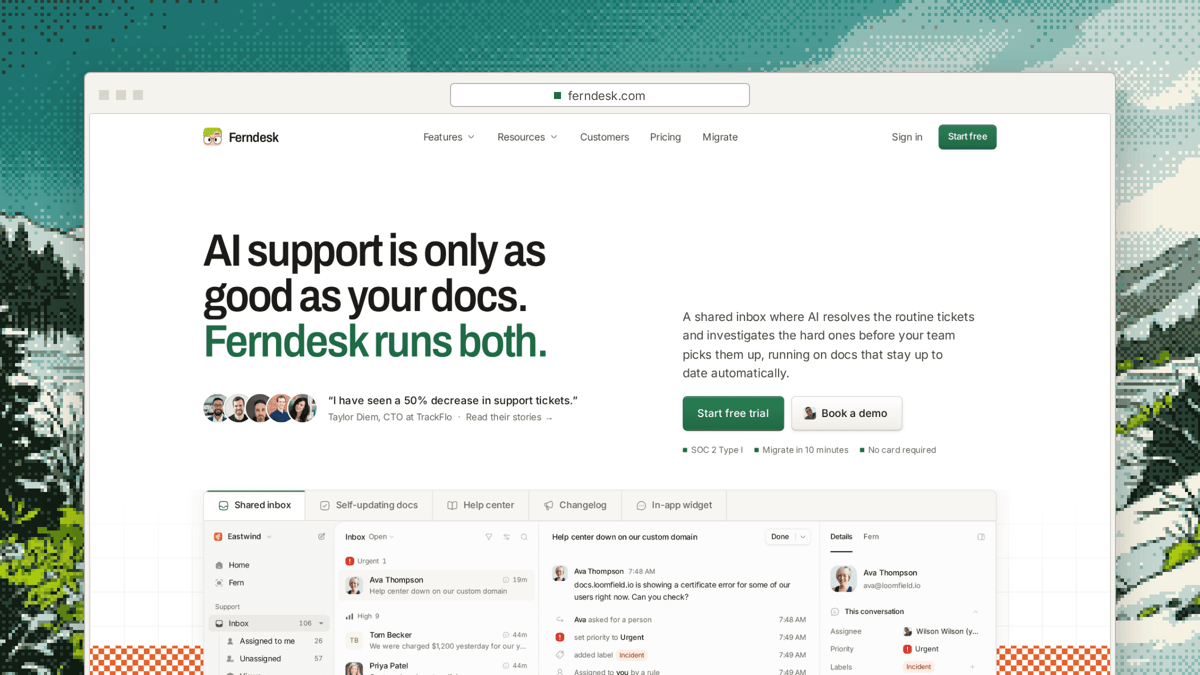
Ferndesk brings an AI-native help center, an embeddable widget with AI chat, and a support inbox for email and live chat into one queue. Our Pro plan is $149 a month (checked Nov 21, 2026), and teams under 5 people pay $75 a month for the first 12 months, starting with a 7-day free trial and no card required. That price includes 5 seats (extra seats are $10 a month), 1,000 conversations a month whoever answers them (500 more for $25), $0 per resolution, custom domain or subfolder hosting (docs.yourcompany.com or yourcompany.com/docs), private help centers, 5 languages, scheduled audits for stale docs, and auto-updates from unlimited merged pull requests.
Fern, our AI agent, connects to GitHub or GitLab with read-only access to detect shipped features and changed flows from merged changes and your changelog, draft article edits, and recapture screenshots from your real product UI. Nothing publishes without a human review, and your data never trains AI models. Ferndesk connects to Linear through Linear’s API, which Linear includes on every plan (Linear pricing page, checked Nov 21, 2026), so no paid Linear tier is needed. Our importers bring past conversations and saved replies from Intercom, Zendesk, Help Scout, and Gmail, plus help center articles with redirects, with done-for-you migration included. You can see the side-by-side breakdown on our Ferndesk vs Intercom page.
Help Scout
Help Scout is a human-first shared inbox paired with a Docs knowledge base, and many teams treat it as the best alternative to Zendesk for startups that want simple email collaboration. Its free plan covers 1 inbox and 1 Docs site, while paid plans run $25 on Standard, $45 on Plus, and $75 on Pro per user a month billed annually (checked Nov 21, 2026). AI resolutions cost $0.75 each. Help Scout handles collaborative email cleanly, though its Docs site does not update itself after a release, leaving doc upkeep on your team.
Crisp
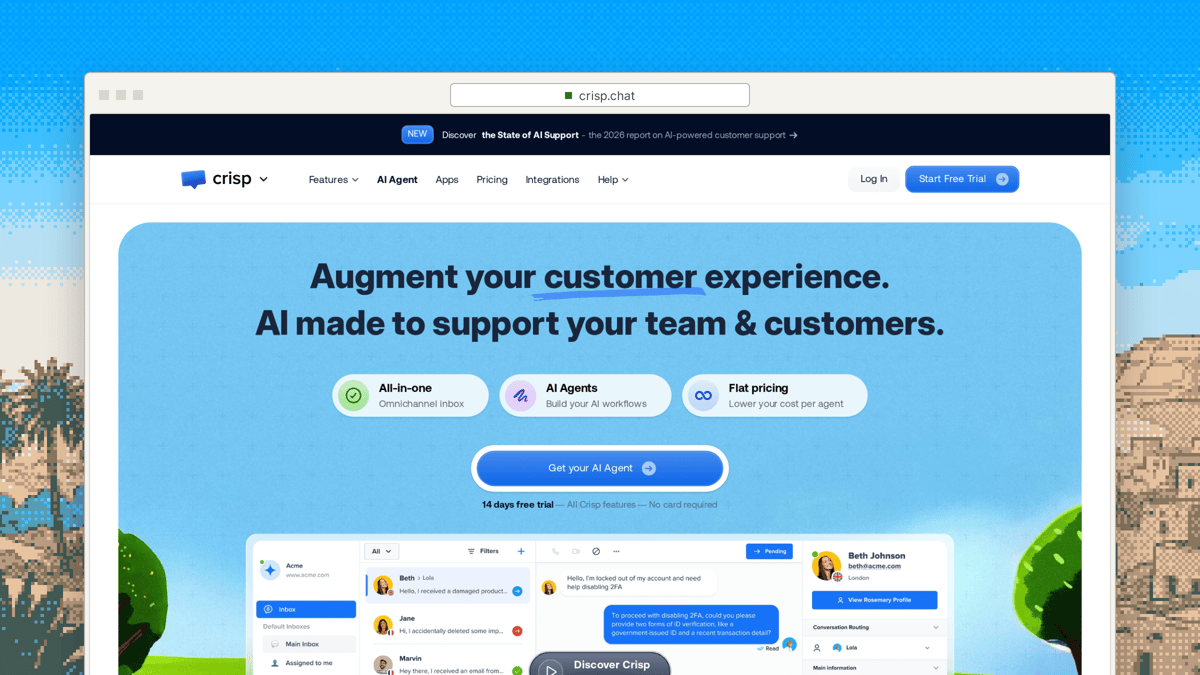
Crisp is a chat-first tool priced per workspace rather than per seat. Its Free plan includes 2 seats with no AI credits, Mini is $45 a month per workspace for 4 seats, a shared email inbox, and $5 of AI credits, Essentials is $95 a month per workspace for 10 seats, a knowledge base, an omnichannel inbox, and $25 of AI credits, and Plus is $295 (checked Nov 21, 2026). Mini is inexpensive if live chat is all you want, though you need Essentials at $95 for a knowledge base, and articles still stay manual after releases.
Intercom
Intercom attracts a lot of early teams through its Early Stage discount. Startups with up to $10M in funding, fewer than 15 employees, and no current Intercom subscription get year one for $65 a month - a 93% discount off the $903 list price - including 6 Advanced seats and 300 free Fin outcomes a month (intercom.com/early-stage and Intercom help article, checked Nov 21, 2026). It packs plenty of workflow depth out of the box, though the steep renewal step-ups push many startups to look at Intercom alternatives by year two.
Two pricing traps to avoid
When founders shop for a startup help desk with automation, two billing rules tend to catch small teams off guard: expiring startup discounts and per-answer AI fees.
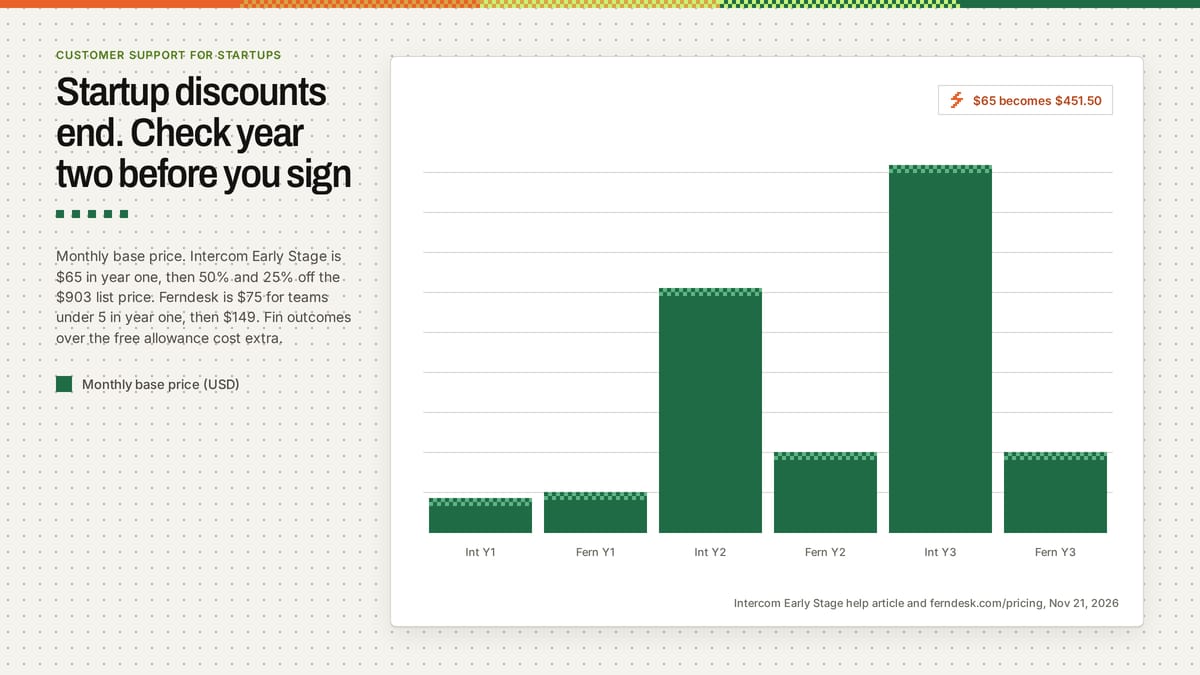
The first trap is the year-two cliff on Intercom Early Stage. After year one at $65 a month, year two drops to 50% off, moving your base bill to $451.50 a month while cutting free Fin outcomes from 300 to 150 (checked Nov 21, 2026). Year three drops to 25% off, or $677.25 a month, with only 75 free Fin outcomes left. Your base price rises more than tenfold over three years even if your headcount never moves.
The second trap is per-resolution AI billing. On Intercom, every Fin outcome past your free allowance costs $0.99 at list price (Intercom pricing page, checked Nov 20, 2026). Help Scout charges $0.75 per AI resolution (checked Nov 21, 2026). Crisp includes $5 or $25 in AI credits on Mini and Essentials before usage kicks in (checked Nov 21, 2026). When every answered doc question adds a fee, your support bill climbs alongside your signup growth. For scalable customer support for software teams, flat conversation pricing with $0 per resolution keeps costs predictable.
What startup support actually costs
Here is how the monthly base cost and AI fees look across years one, two, and three for a small team.
| Tool | Year 1 / mo | Year 2 / mo | Year 3 / mo | AI resolution fee | Checked |
|---|---|---|---|---|---|
| Ferndesk (under 5 people) | $75 | $149 | $149 | $0 (1,000 conversations included) | Nov 21, 2026 |
| Intercom Early Stage | $65 | $451.50 | $677.25 | $0.99 after 300 / 150 / 75 free | Nov 21, 2026 (list Nov 20, 2026) |
| Help Scout Standard (3 users) | $75 | $75 | $75 | $0.75 per resolution | Nov 21, 2026 |
| Crisp Mini (4 seats) | $45 | $45 | $45 | Usage after $5 AI credits | Nov 21, 2026 |
Crisp Mini has the lowest base price, though adding a knowledge base requires Essentials at $95 a month (checked Nov 21, 2026). Help Scout keeps seats steady at $75 for three people, then layers $0.75 onto every AI resolution. Intercom Early Stage saves $10 a month against Ferndesk in year one before jumping to $451.50 in year two.
When to outsource customer support
Many founders searching for support tools are really wondering if they can hand the inbox to an outside contractor. At 1 to 5 people, the answer is no: the founder or CTO should answer support.
For a small B2B software team serving non-technical buyers, support tickets are the clearest product feedback you get. Every question points to a confusing screen, a broken flow after a deploy, or a gap in onboarding. If you outsource support while the product is still changing weekly, you pay someone else to hide the exact signals you need to fix. Keep the queue in-house, let an AI agent deflect documented questions and draft bug tickets, and consider outsourcing later only if routine volume on a stable product begins crowding out engineering.
How I checked this
I am Wilson, founder of Ferndesk. Before this I co-founded Senja, a testimonial tool, and grew it to $850K ARR over 3.5 years. Today I still run every Ferndesk demo call myself, and our team runs Ferndesk’s own support on Ferndesk’s inbox.
Because we build and run importers that move past conversations, saved replies, and articles with redirects off Intercom, Zendesk, Help Scout, and Gmail, I see how small teams run those tools up close. We have not run Crisp ourselves, so that section relies on Crisp’s pricing page and docs.
I read every vendor pricing page and Intercom’s Early Stage terms on Nov 21, 2026, plus Intercom’s $0.99 Fin outcome list price on Nov 20, 2026. I judged every tool on four criteria:
- Total monthly cost in years one to three
- AI pricing (per resolution or included)
- Whether the help center stays current after releases
- Setup time for a founder shipping between tickets
We build Ferndesk and rank it first, so treat our spot with the grain of salt it deserves. There are no paid spots and no affiliate links, prices carry check dates and get rechecked on updates, and corrections sent to [email protected] are dated on the page.
Frequently asked questions
How should a startup handle customer support?
Run one shared inbox for email and live chat alongside an accurate help center, with the founder answering tickets early on. Let AI answer repeat questions strictly from your articles and draft Linear bug issues so you stay focused on shipping. When you answer a new question, turn that thread into an article before moving on.
When should a startup hire or outsource support?
Hold off on hiring or outsourcing support until your team passes 5 people and your core workflows stop changing every week. At 1 to 5 people, tickets show you directly where non-technical customers struggle and what is breaking in production. Outsourcing too early separates the people writing code from real customer pain.
What is the cheapest help desk for a startup?
Gmail is free for a solo founder, while Crisp Free gives you 2 seats without AI credits and Help Scout offers a free plan capped at 1 inbox and 1 Docs site (checked Nov 21, 2026). On paid plans, Crisp Mini is $45 a month per workspace without a knowledge base, and Ferndesk is $75 a month for teams under 5 in year one with an inbox, AI agent, and self-updating docs included (checked Nov 21, 2026).
Is Intercom’s Early Stage program worth it?
It makes sense only if you need Intercom’s deeper workflows immediately and are ready to pay $451.50 a month in year two (checked Nov 21, 2026). The $65 year-one rate comes from a 93% discount that falls to 50% in year two and 25% in year three ($677.25 a month), while free Fin outcomes shrink from 300 to 75.
Do startups need a help center from day one?
Yes, you should publish core setup and billing guides as soon as customers start paying. Accurate docs cut repeat onboarding questions and give an AI agent verified answers to cite. Skipping a help center guarantees you answer the same questions by hand all week.
Sources
- Ferndesk pricing and product (ferndesk.com/pricing), checked Nov 21, 2026
- Help Scout pricing page, checked Nov 21, 2026
- Crisp pricing page, checked Nov 21, 2026
- Intercom Early Stage help article and program page (intercom.com/early-stage), checked Nov 21, 2026
- Intercom pricing page ($0.99 per Fin outcome), checked Nov 20, 2026
- Linear pricing page (API included on every plan), checked Nov 21, 2026
Start a 7-day free trial with no card required on our pricing page.


 Book a demo