

Most companies hire a technical writer too late. They wait until support tickets are overflowing, customers are frustrated, and the product has changed so much that nobody remembers how half of it works. Then they expect one hire to fix years of neglect.
That’s not fair to the writer. And it rarely works.
If you’re thinking about hiring a technical writer, this guide will help you do it right. We’ll cover the economics, the job market, the interview process, and an honest look at when you might not need a full-time hire at all.
Do You Actually Need a Technical Writer?
Before you post a job, ask yourself why you need one. Technical writers solve specific problems:
- Documentation debt. Your product has features, but nobody’s written down how to use them.
- Support volume. You’re answering the same questions repeatedly because they aren’t documented.
- Customer churn. Users leave because they can’t figure out your product, not because your product is bad.
- Scaling onboarding. You can’t personally walk every customer through setup anymore.
If these problems sound familiar, a technical writer can help. But if your real issue is product complexity or poor UX, documentation won’t fix that. You’ll just be documenting a confusing product, which is lipstick on a pig.
The honest question: Are you hiring a technical writer to create documentation, or to avoid fixing underlying product problems? Be honest with yourself.
What Technical Writers Cost
Let’s talk money. In 2026, here’s what you’ll pay:
Full-Time Salaries (US)
| Experience Level | Annual Salary | Hourly Equivalent |
|---|---|---|
| Entry-level (0-2 years) | $55,000-$70,000 | $26-$34/hr |
| Mid-level (3-5 years) | $70,000-$85,000 | $34-$41/hr |
| Senior (5+ years) | $85,000-$110,000 | $41-$53/hr |
| Lead/Principal | $100,000-$130,000+ | $48-$63/hr |
Add 20-30% for benefits, equipment, and overhead. A $80,000 salary really costs you $100,000.
Location matters. Writers in San Francisco or New York command 15-25% premiums. Remote roles from lower cost-of-living areas save money without sacrificing talent.
Freelance Rates
| Experience | Hourly Rate | Per-Word Rate |
|---|---|---|
| Entry-level | $20-$35/hr | $0.10-$0.20 |
| Mid-level | $35-$50/hr | $0.20-$0.50 |
| Senior/Specialist | $50-$100/hr | $0.50-$1.00+ |
Freelancers on platforms like Upwork typically charge $20-$45/hour, with a median of $30/hour. Experienced specialists in niche fields (API documentation, medical/legal technical writing) charge $75-$100+.
Agency Rates
Documentation agencies charge $100-$200/hour or project-based fees. They’re expensive but useful for one-time documentation overhauls when you don’t need ongoing work.
Full-Time vs. Freelance vs. AI
Here’s the decision matrix most companies skip:
| Factor | Full-Time | Freelance | AI Tools |
|---|---|---|---|
| Upfront cost | High ($80K+/year) | Medium ($3K-$10K/month) | Low ($50-$500/month) |
| Product knowledge | Deep over time | Limited per project | Can learn from codebase |
| Availability | Always | As contracted | Always |
| Maintenance | Great | Poor | Automated |
| Quality control | You manage | Variable | You review |
Full-time makes sense when:
- You ship frequently and docs need constant updates
- Documentation is a competitive advantage
- You need someone embedded in the product team
Freelance makes sense when:
- You have a one-time documentation project
- You need specialized expertise (API docs, compliance)
- You’re testing whether documentation moves the needle
AI tools make sense when:
- You’re a small team without dedicated documentation resources
- You need documentation that automatically stays current
- You want to augment (not replace) human writers
The smartest approach is usually hybrid. Use AI to handle first drafts and maintenance, humans to ensure accuracy and handle complex content.
Where to Find Technical Writers
Before you start sourcing, you’ll need a job posting. We have a ready-to-use technical writer job description template with customization guidance.
Job Boards
Specialized:
- Write the Docs Job Board is the gold standard for technical writing roles
- Technical Writer HQ has salary guides and job listings
- Society for Technical Communication for established professionals
General:
- LinkedIn (filter for “Technical Writer” and relevant tools)
- Indeed, Glassdoor for volume
- AngelList/Wellfound for startup-focused writers
Freelance Platforms
- Upwork has the largest pool, quality varies significantly
- Toptal for pre-vetted senior talent (expensive)
- Contently for content specialists
- ProBlogger for writers who understand content marketing
Communities
The best candidates often aren’t actively job hunting. Find them where they hang out:
- Write the Docs Slack is incredibly active
- r/technicalwriting on Reddit
- Tech Twitter/X (search for #TechComm)
- Local Write the Docs meetups
What to Look For
Must-Haves
Writing ability. Obvious, but often overlooked. Ask for samples that match your content type. API docs require different skills than help center articles.
Technical aptitude. They don’t need to code, but they need to understand technical concepts and learn your product quickly. Look for evidence they’ve documented software before.
Curiosity. Great technical writers ask a lot of questions. They’re not satisfied with surface-level understanding.
Organization skills. Documentation projects balloon without structure. You need someone who can plan, not just write.
Nice-to-Haves
- Experience with your documentation tools (but tools can be learned)
- Background in your industry (fintech, healthcare, dev tools)
- Experience with docs-as-code workflows (Git, Markdown, CI/CD)
- Analytics mindset (tracking what docs get read, what’s missing)
Red Flags
- Can’t explain technical concepts simply in conversation
- Portfolio shows only one content type
- No questions about your product or users
- Focuses only on word count or quantity metrics
The Interview Process
For a deep dive on what to ask candidates, see our guide on technical writer interview questions. Here’s the high-level process.
Step 1: Portfolio Review
Before anything else, look at their work. Request:
- 2-3 samples that match what you need
- At least one sample where they had to learn something technical
- If possible, samples from different companies (shows range)
What to evaluate:
- Is the writing clear and scannable?
- Does it explain the “why,” not just the “how”?
- Would a user actually find what they need?
Step 2: Screening Call (30 minutes)
Cover the basics:
- Walk me through how you approached [specific sample]
- What’s your process for learning a new product?
- How do you handle conflicting feedback from engineers vs. product vs. users?
- What documentation tools have you used?
Step 3: Writing Exercise (take-home)
Give them a real task, something small from your product. Ask them to:
- Learn about a feature from existing materials (give them access)
- Write a help article or guide
- Explain their process and decisions
Pay them for this. $100-$300 for a few hours of work. Unpaid exercises signal you don’t value their time.
Evaluate:
- How quickly did they understand the product?
- Did they ask clarifying questions?
- Is the output something you could publish with minor edits?
Step 4: Team Interview (1 hour)
Include people the writer will work with daily: product managers, engineers, support. Test for collaboration:
- How would you get technical information from a busy engineer?
- Tell me about a time you disagreed with feedback on your writing.
- How do you prioritize when everything is “urgent”?
Step 5: Reference Check
Actually call their references. Ask specifically:
- How did they handle complex technical topics?
- Were they self-directed or did they need constant guidance?
- Would you hire them again?
Onboarding Your Technical Writer
Hiring is only half the battle. Most technical writer onboarding fails because companies don’t set them up for success.
Week 1: Immersion
- Product walkthrough (not just features, but why they exist)
- Access to support tickets, customer feedback, sales calls
- Introduction to key stakeholders (engineering, product, support)
- Audit of existing documentation (if any)
Week 2-4: Quick Wins
- One complete piece of documentation, start to finish
- Feedback loop established with subject matter experts
- Documentation style guide created or adopted
Month 2-3: System Building
- Content calendar or roadmap established
- Processes for staying informed about product changes
- Analytics tracking implemented
- Regular sync with product/engineering
The most common mistake: Treating technical writers like isolated content factories. The best technical writers are embedded in product teams, attending standups, reviewing PRs, listening to support calls. Information access determines documentation quality.
An Alternative: AI-Powered Documentation
Here’s something most “how to hire a technical writer” guides won’t tell you: you might not need one.
For many teams, especially early-stage startups and small companies, dedicated technical writing headcount is overkill. The economics don’t work when you’re trying to stay lean.
The alternative? AI documentation tools that can:
- Read your codebase and understand what your product does
- Analyze support tickets to identify what’s not documented
- Draft articles matching your existing tone and style
- Flag content that’s gone stale
- Keep documentation updated as your product changes
This isn’t theoretical. Ferndesk does exactly this.
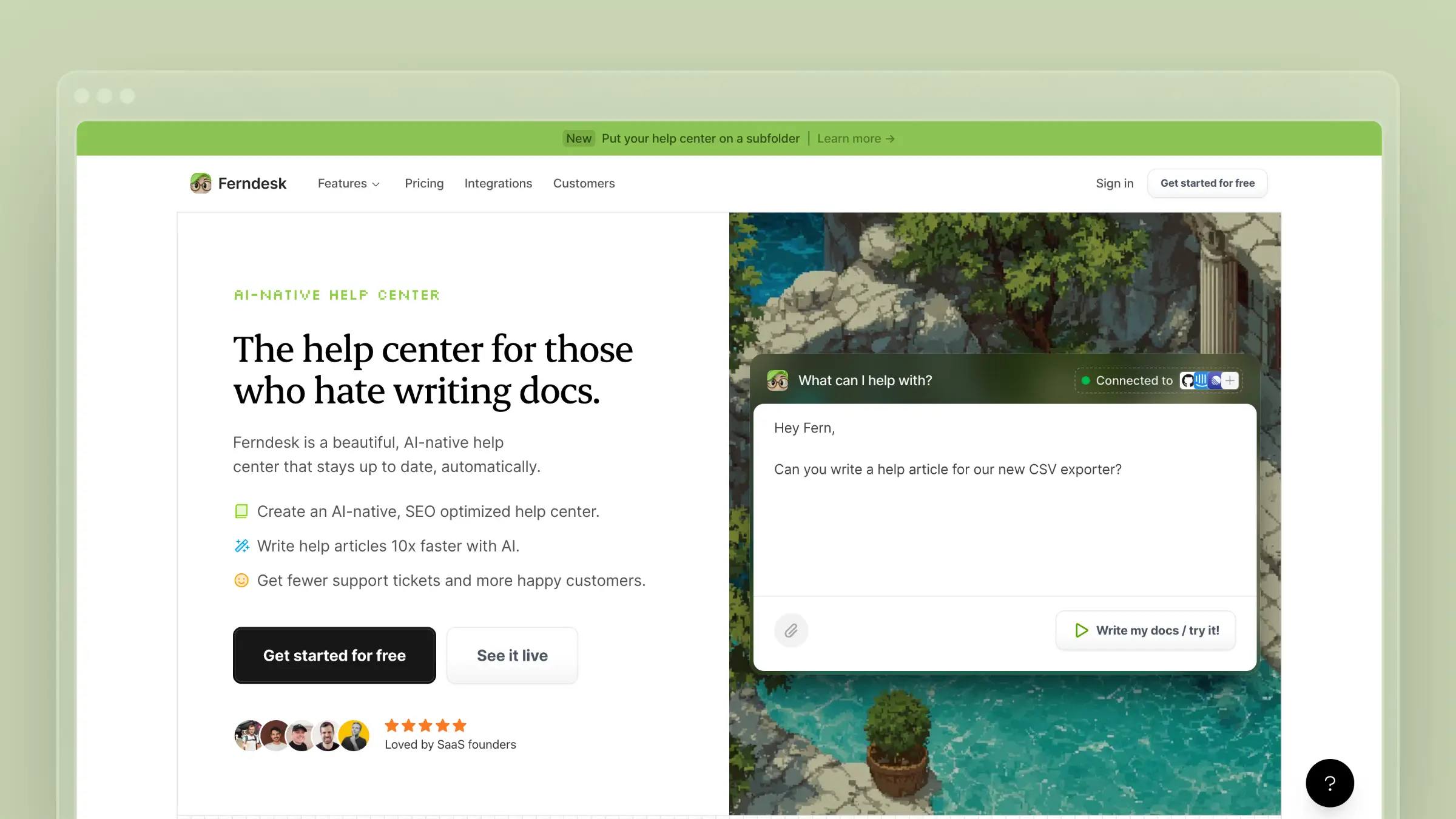
Our AI agent, Fern, works like a junior technical writer who never sleeps, never misses a product update, and learns from every customer interaction.
| Approach | Annual Cost | Maintenance | Scalability |
|---|---|---|---|
| Full-time technical writer | $80,000-$130,000 | Manual | Limited by hours |
| Freelance (ongoing) | $36,000-$120,000 | Project-based | Flexible |
| Ferndesk | $1,490/year | Automated | Unlimited |
The caveat: AI works best for help centers and customer documentation. For complex API references, compliance documentation, or highly regulated industries, you’ll still want human expertise.
The sweet spot: Use AI for first drafts, maintenance, and identifying gaps. Use human writers (full-time or freelance) for complex content that requires deep expertise or nuanced judgment.
Making the Decision
Here’s how to decide what’s right for your situation:
Hire full-time if:
- Documentation is core to your product’s value proposition
- You ship features weekly and docs need to keep pace
- You can afford $100K+ annually (fully loaded)
- You have enough work for 40 hours/week
Use freelancers if:
- You need a one-time documentation overhaul
- You have specialized needs (API docs, compliance)
- You want to test whether documentation moves business metrics
- You need flexibility to scale up or down
Use AI tools if:
- You’re a small team without dedicated documentation resources
- You need docs that stay current automatically
- You want to augment existing writers, not replace them
- You’re trying to reduce support ticket volume quickly
Most successful teams combine approaches. AI handles the maintenance and first drafts. Humans handle strategy, complex content, and final review.
The Bottom Line
Technical writers are valuable. Good ones transform chaotic product knowledge into documentation that reduces support costs, improves customer success, and makes your product easier to sell.
But they’re not the only option anymore. Before committing $100K+ to a hire, consider whether AI-powered documentation tools could solve your immediate problem at a fraction of the cost.
If you do hire, hire well. Look for curiosity and technical aptitude over perfect writing samples. Set them up for success with product access and information flow. And measure the impact of documentation on real business metrics, not just word counts.
If you want to see what AI-powered documentation can do first, try Ferndesk free for 7 days. You might find you need less headcount than you thought.


 Book a demo