

Bad job descriptions attract bad candidates. Vague requirements, missing salary info, and endless bullet points signal a company that doesn’t know what it wants.
Good technical writers have options. They skip postings that waste their time.
Here’s a job description template that actually works, plus guidance on customizing it for your specific needs.
The Template
Copy this and customize the bracketed sections.
Technical Writer at [Company Name]
Location: [City, State / Remote / Hybrid] Salary: [$XX,000 - $XX,000] + [benefits summary] Employment Type: [Full-time / Contract / Part-time]
About the Role
We’re looking for a technical writer to own [customer documentation / developer docs / internal knowledge base] at [Company Name]. You’ll turn complex product knowledge into clear, useful content that helps [customers accomplish X / developers integrate Y / teams work efficiently].
This isn’t a content factory role. You’ll work closely with [engineering, product, support] to understand what users actually need, then create documentation that reduces confusion and support tickets.
What You’ll Do
- Create and maintain [help articles / API documentation / user guides / internal wikis] for [product/audience]
- Interview subject matter experts and translate technical concepts into clear writing
- Analyze [support tickets / user feedback / search data] to identify documentation gaps
- Establish and maintain documentation standards and style guides
- [If applicable: Manage documentation tools and publishing workflows]
- [If applicable: Create screenshots, diagrams, or video tutorials]
What We’re Looking For
Required:
- X years of technical writing experience (or equivalent)
- Portfolio demonstrating clear, user-focused writing
- Ability to learn complex technical concepts quickly
- Experience working with engineers and product teams
- [Tool/skill specific to your stack, e.g., “Familiarity with REST APIs” or “Experience with docs-as-code workflows”]
Nice to have:
- Experience in [your industry: SaaS, fintech, developer tools, etc.]
- Familiarity with [specific tools: Git, Markdown, your documentation platform]
- Background in [relevant field: software development, UX, support]
What We Offer
- Salary: [$XX,000 - $XX,000] based on experience
- [Health insurance / equity / 401k / etc.]
- [Remote flexibility / office perks]
- [PTO policy]
- [Professional development budget / conference attendance]
About [Company Name]
[2-3 sentences about your company, product, and what makes you interesting. Focus on the mission or problem you solve, not generic startup speak.]
How to Apply
Send your resume and 2-3 writing samples to [email] or apply at [link]. Writing samples should demonstrate your ability to explain technical concepts clearly.
Before You Customize This Template
A full-time technical writer costs $70,000-$130,000 annually (plus benefits and overhead). That’s the right investment if you have ongoing documentation needs and enough work for 40 hours per week.
But if you’re a smaller team or your documentation needs are more sporadic, you might not need a full-time hire at all. Ferndesk offers an AI documentation agent that drafts and maintains help articles automatically for $149/month or $1,490/year. Many teams use it instead of hiring, or use it to reduce the scope of a future hire.
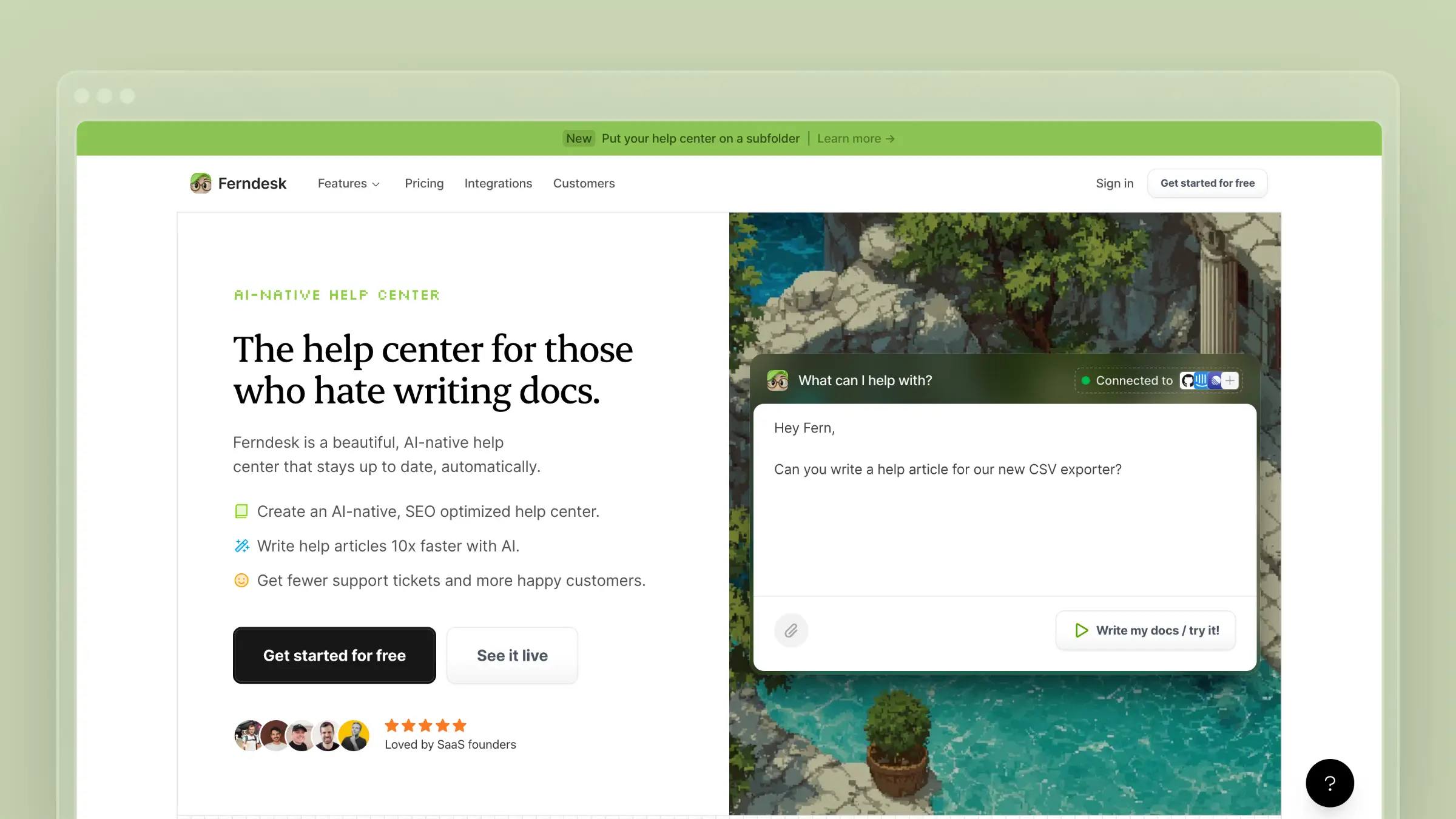
Worth considering before you spend weeks on a hiring process.
Customization Guide
Salary: Always Include It
Research shows that job postings with salary ranges get significantly more qualified applicants. Technical writers, especially good ones, won’t waste time on postings that hide compensation.
2026 salary benchmarks (US):
| Level | Salary Range |
|---|---|
| Entry (0-2 years) | $55,000 - $70,000 |
| Mid (3-5 years) | $70,000 - $90,000 |
| Senior (5+ years) | $90,000 - $120,000 |
| Lead/Principal | $110,000 - $140,000 |
Adjust based on location. San Francisco and New York run 15-25% higher. Remote roles from anywhere can pay market rate or adjust for cost of living.
Requirements: Be Specific, Not Exhaustive
Bad:
- 5+ years of technical writing experience
- Excellent communication skills
- Detail-oriented
- Team player
- Proficiency in Microsoft Office
This tells candidates nothing and attracts everyone.
Good:
- 2+ years writing software documentation (help centers, API docs, or user guides)
- Experience interviewing engineers and translating technical concepts
- Familiarity with Git-based workflows or willingness to learn
- Portfolio showing clear, structured technical content
This filters for relevant experience and signals you know what you need.
Title: Keep It Standard
Use “Technical Writer” unless you have a specific reason not to. Fancy titles like “Documentation Engineer” or “Content Architect” make it harder for candidates to find your posting.
Seniority prefixes are fine: “Senior Technical Writer” or “Staff Technical Writer.”
Remote vs. On-Site: Be Clear
Don’t say “flexible” if you really mean “in office 3 days a week.” State your policy clearly:
- Fully remote: Work from anywhere (specify timezone requirements if any)
- Hybrid: In office X days per week at [location]
- On-site: Based in [location] office
Tools: Don’t Require Everything
New tools can be learned in weeks. Don’t eliminate great candidates because they haven’t used your specific documentation platform.
Reasonable requirements:
- Familiarity with Markdown or structured writing
- Experience with version control (Git) or willingness to learn
- Comfort learning new documentation tools
Unreasonable requirements:
- “Must have 3+ years experience with [obscure tool]”
- “Expert in Confluence, Notion, GitBook, Docusaurus, AND ReadMe”
The “About Us” Section
Skip the buzzwords. Don’t say you’re “revolutionizing” or “disrupting” anything. Technical writers are skeptical by nature.
Bad: “We’re a fast-paced, innovative startup disrupting the B2B SaaS space with our cutting-edge AI-powered platform.”
Good: “We build help center software for SaaS companies. Our customers include [notable names]. We’re a team of 25, profitable, and growing.”
Specifics beat adjectives.
Red Flags That Scare Away Good Candidates
Avoid these in your job description:
“Wears many hats” = We don’t know what we need and you’ll do random tasks.
“Fast-paced environment” = Chaotic with poor planning.
“Rockstar” or “Ninja” = We have immature hiring practices.
“Unlimited PTO” = We don’t actually track time off (often means people take less).
No salary listed = We’re either cheap or disorganized.
20+ bullet points of requirements = We’ll never find this person.
“Other duties as assigned” = This job is undefined.
Job Description Variations
For API/Developer Documentation
Add to responsibilities:
- Write and maintain API reference documentation
- Create code samples in [languages your API supports]
- Work with developer relations to ensure docs support adoption
- [If applicable: Maintain OpenAPI/Swagger specifications]
Add to requirements:
- Understanding of REST APIs and HTTP methods
- Ability to read code in [relevant languages]
- Experience writing for developer audiences
For Customer Help Centers
Add to responsibilities:
- Write help articles that reduce support ticket volume
- Analyze support data to identify documentation gaps
- Maintain and organize knowledge base structure
- [If applicable: Create video tutorials and visual guides]
Add to requirements:
- Experience writing customer-facing documentation
- Understanding of support workflows and user needs
- SEO awareness for help content discovery
For Internal Documentation
Add to responsibilities:
- Document internal processes, policies, and procedures
- Create onboarding materials for new employees
- Work with department heads to maintain accurate information
- Establish standards for internal documentation
Add to requirements:
- Experience with internal knowledge management
- Ability to work across departments
- Understanding of information architecture
Before You Post
Checklist:
- Salary range included
- Requirements are specific and reasonable (under 10 bullet points)
- Clear location/remote policy
- Accurate description of day-to-day work
- No jargon or buzzwords in company description
- Instructions for how to apply
- Portfolio/samples requested
Consider Your Alternatives
Before posting a full-time role, make sure you actually need one. If your documentation needs are sporadic or you’re a small team, you might get better results from:
- Freelance writers for specific projects (where to find them)
- AI documentation tools for ongoing maintenance and first drafts
- Contractors for documentation overhauls
One option worth considering: Ferndesk provides an AI documentation agent that reads your codebase and support tickets to draft and maintain help articles. At $149/month or $1,490/year, it costs a fraction of a full-time hire and handles the repetitive maintenance work that bogs down technical writers.
Many teams use it to bridge the gap until they’re ready for dedicated headcount, or to make an eventual hire focus on strategic work instead of content treadmills.
For more on deciding between full-time, freelance, and AI options, see our complete guide on how to hire a technical writer.
The Interview Process
Once candidates apply, you’ll need to evaluate them. We’ve written a separate guide on technical writer interview questions that covers:
- Questions that reveal actual ability (not just experience)
- How to structure a writing exercise
- Red flags to watch for
- What great candidates ask you
Good luck with your search.


 Book a demo