

Most technical writer interviews are useless. They ask about favorite writing tools, years of experience, and whether the candidate knows Markdown. None of that predicts job performance.
The questions that matter reveal two things: Can this person figure things out on their own? Can they explain complex ideas simply?
Here are the interview questions that actually surface those answers.
Questions About Process
These reveal how candidates think about documentation work, not just whether they can write.
“Walk me through how you’d document a feature you’ve never seen before.”
What you’re looking for: A systematic approach. Good candidates mention talking to engineers, using the product themselves, checking support tickets for common questions, and looking at existing docs for style and structure.
Red flag: Jumping straight to writing without research, or expecting someone else to hand them all the information.
“You have a busy engineer who’s the only person who understands a critical feature. They keep rescheduling your meetings. What do you do?”
What you’re looking for: Resourcefulness and professionalism. Good answers include: reviewing their code commits or PRs, checking Slack history, preparing specific questions to maximize limited time, escalating appropriately if needed.
Red flag: Passive acceptance (“I’d just wait”) or blame (“That’s a management problem”).
“How do you decide what to document first when everything is ‘urgent’?”
What you’re looking for: Prioritization frameworks. Smart candidates mention: support ticket volume, customer-facing vs. internal, revenue impact, frequency of questions, or asking stakeholders to stack-rank.
Red flag: No framework at all, or deferring entirely to others without input.
“Tell me about documentation you decided NOT to write. Why?”
What you’re looking for: Judgment. Not everything needs documentation. Good candidates recognize when inline UI text, better error messages, or product changes are better solutions than more docs.
Red flag: Never questioning whether documentation is the right solution.
Questions About Writing
These test actual communication skills, not just credentials.
“Explain [something technical from your product] to me like I’m a new customer.”
What you’re looking for: Clarity without condescension. They should ask clarifying questions about the audience, then deliver a clear explanation that builds logically.
Red flag: Using jargon without defining it, or over-explaining obvious things while glossing over confusing parts.
“Here’s a paragraph from our current docs. How would you improve it?”
Give them something real from your documentation (ideally something mediocre, not terrible).
What you’re looking for: Specific, actionable feedback. Good candidates identify unclear antecedents, missing context, passive voice, or structure issues. Great candidates ask who the audience is before answering.
Red flag: Vague feedback (“It’s fine” or “Make it more engaging”) or only catching typos.
“What’s the difference between documentation and marketing copy?”
What you’re looking for: Understanding of purpose. Documentation helps users accomplish tasks. Marketing persuades. The tone, structure, and success metrics differ completely. Good candidates know they might need to push back on “make it sound exciting.”
Red flag: Treating them as interchangeable, or not understanding why this matters.
“How do you handle feedback you disagree with?”
What you’re looking for: Professional disagreement. Good candidates explain their reasoning, ask questions to understand the feedback giver’s perspective, and know when to push back vs. when to defer.
Red flag: Always agreeing to avoid conflict, or dismissing feedback without consideration.
Questions About Technical Aptitude
Technical writers don’t need to code, but they need to understand technical concepts quickly.
“What’s the most technically complex thing you’ve documented? What made it hard?”
What you’re looking for: Evidence they’ve worked through complexity, not around it. Good candidates describe specific challenges (unfamiliar domain, conflicting information sources, rapidly changing features) and how they solved them.
Red flag: Only documenting simple user interfaces, or blaming complexity on others.
“How comfortable are you with [relevant technology: APIs, command line, code snippets]?”
Adjust based on your needs. If you need someone to document APIs, ask about REST vs. GraphQL. If they’ll work with developers, ask about Git workflows.
What you’re looking for: Honest self-assessment and willingness to learn. “I haven’t worked with GraphQL, but I documented REST APIs for three years and learned X on my own” is a great answer.
Red flag: Overstating abilities (you’ll discover this quickly) or dismissing technical skills as unnecessary.
“You find an error in the engineering spec. What do you do?”
What you’re looking for: Initiative and communication skills. Good candidates verify the error, document what they found, and communicate it appropriately (not publicly embarrassing the engineer).
Red flag: Ignoring it, or making a big deal without verifying.
Questions About Collaboration
Documentation is a team sport. These questions reveal how candidates work with others.
“How do you get buy-in for documentation standards or style guides?”
What you’re looking for: Influence without authority. Good candidates talk about showing value, starting small, getting early adopters, and making compliance easy.
Red flag: Expecting mandate from above, or dismissing standards as unnecessary.
“Tell me about a time you got conflicting feedback from different stakeholders.”
What you’re looking for: Diplomatic navigation. Good candidates describe understanding each perspective, finding common ground, escalating when necessary, and documenting decisions.
Red flag: Always siding with the loudest voice, or never pushing back.
“How do you know if your documentation is working?”
What you’re looking for: Measurement mindset. Good answers include: analytics (page views, search terms, time on page), support ticket deflection, user feedback, search result quality, or direct user testing.
Red flag: “If no one complains, it’s working” or no interest in measurement.
The Writing Exercise
Don’t rely solely on interviews. Give candidates a real task.
How to Structure It
- Give them access to your product (sandbox account, demo, or recorded walkthrough)
- Assign a specific task: “Write a help article explaining how to [specific feature]”
- Set a reasonable deadline: 2-4 hours of work, with 2-3 days to complete
- Pay them: $150-$300. Unpaid exercises disrespect their time and bias toward candidates who can afford to work free.
What to Evaluate
- Speed of comprehension: Did they understand the feature from limited materials?
- Questions asked: Smart questions show critical thinking. No questions might mean they guessed.
- Structure: Is the article organized logically? Can users find what they need?
- Clarity: Would a real user understand this?
- Style match: Did they attempt to match your existing docs’ tone?
Sample Scoring Rubric
| Criteria | 1 (Poor) | 3 (Acceptable) | 5 (Excellent) |
|---|---|---|---|
| Accuracy | Factual errors | Mostly correct | Completely accurate |
| Clarity | Confusing | Understandable | Crystal clear |
| Structure | No logic | Basic organization | Perfect flow |
| Completeness | Missing key info | Covers basics | Anticipates questions |
| Style | Doesn’t match | Attempts to match | Nails the tone |
Questions to Avoid
Some common interview questions waste everyone’s time:
“What’s your favorite documentation tool?” Tools can be learned in a week. This tells you nothing.
“How many years of experience do you have?” A 3-year writer who shipped great docs beats a 10-year writer who produced mediocre ones.
“Tell me about yourself.” Too open-ended. Ask specific questions about their work.
“Where do you see yourself in 5 years?” Irrelevant to job performance.
“What’s your greatest weakness?” You’ll get rehearsed non-answers.
What Great Candidates Ask You
Pay attention to their questions. Strong candidates ask about:
- Documentation’s role in the company (strategic or afterthought?)
- Current state of docs (greenfield or maintenance?)
- Review and approval processes
- Tools and publishing workflow
- How success is measured
- Team structure and collaboration with engineering/product
- Biggest documentation challenges right now
If they don’t ask anything, that’s a red flag. Either they’re not curious, or they’re not serious about the role.
Building Your Interview Process
Here’s a complete interview structure that works:
| Stage | Duration | Focus |
|---|---|---|
| Portfolio review | Async | Writing quality, range |
| Phone screen | 30 min | Basic fit, process questions |
| Writing exercise | Take-home | Actual ability |
| Team interview | 60 min | Collaboration, technical aptitude |
| Reference check | 20 min | Verify claims |
For a detailed breakdown of the full hiring process, see our guide on how to hire a technical writer.
A Final Thought
The best technical writers are curious people who happen to write well. They dig into complex topics, ask smart questions, and translate expert knowledge into user-friendly content.
Your interview process should surface curiosity and communication skills, not just writing credentials. The questions above do that.
Not Ready to Hire?
If you’re finding it hard to justify a full-time hire, you’re not alone. Many teams need better documentation but can’t commit $100K+ annually to headcount.
Ferndesk offers an alternative: an AI documentation agent that reads your codebase, analyzes support tickets, and drafts help articles automatically. It handles the maintenance burden that burns out technical writers, letting you either delay a hire or make a future hire more strategic.
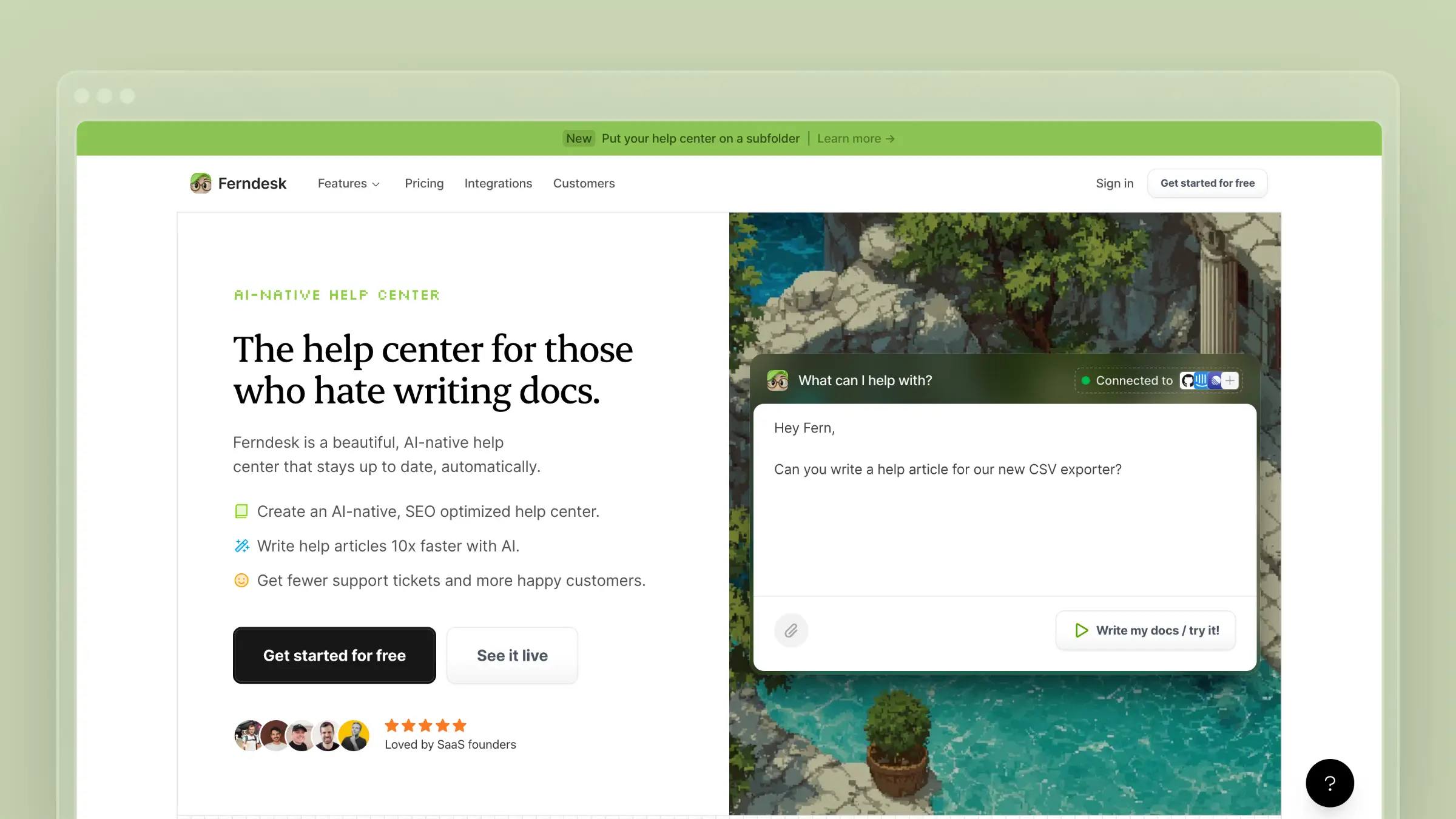
Start with a 7-day free trial to see if AI can cover your immediate documentation needs. You might find you need a different kind of hire, or none at all.


 Book a demo