

Docusaurus is free. That’s the headline everyone knows. Meta built it, open-sourced it, and now thousands of projects use it for documentation. React Native, Redux, Jest, Snapchat. The list goes on.
But “free” has asterisks. Docusaurus costs nothing to download. It costs plenty to set up, host, maintain, and customize. Whether those costs are worth it depends entirely on whether you have engineering resources sitting around waiting for documentation work.
This review covers what Docusaurus actually delivers, what it costs in practice, and who should (and shouldn’t) use it.
What Is Docusaurus?
Docusaurus is a static site generator built specifically for documentation websites. You write content in Markdown (or MDX, which lets you embed React components), and Docusaurus transforms it into a fast, searchable documentation site.
The project started at Facebook (now Meta) to standardize documentation across their open-source projects. Version 2.0 (released in 2022) rebuilt everything on React and added modern features like MDX support, versioning, and a plugin system. The current stable version is 3.10.2.
Key characteristics:
- Static site generator (outputs HTML, CSS, JavaScript)
- Markdown/MDX content authoring
- React-based for customization
- Self-hosted (you choose where to deploy)
- MIT licensed (truly open source)
Docusaurus is not a hosted service. It’s a tool you run to build a site, which you then deploy wherever you want.
Who Uses Docusaurus?
Docusaurus has become the default choice for many categories of documentation:
Open-source projects: React Native, Redux Toolkit, Testing Library, Prettier, and hundreds of other projects use Docusaurus for public documentation.
Developer tools: Companies like Ionic, Temporal, and Hasura use Docusaurus for API and SDK documentation.
Internal documentation: Some engineering teams use Docusaurus for internal technical docs, leveraging the same tools they use for code.
The common thread: developer-centric organizations with engineering resources available for documentation infrastructure.
Docusaurus Pricing: The Real Numbers
Docusaurus itself costs $0. The software is free to download, modify, and use. But the total cost of ownership is not zero. For a detailed breakdown, see our Docusaurus pricing guide.
Software Cost
| Component | Cost |
|---|---|
| Docusaurus | Free |
| Algolia Search (open source tier) | Free |
| Basic themes | Free |
Hosting Costs
You need somewhere to deploy your built site. Options range from free to expensive:
| Hosting Option | Cost | Notes |
|---|---|---|
| GitHub Pages | Free | Public repos only, limited customization |
| Vercel (free tier) | Free | 100GB bandwidth, good for small sites |
| Netlify (free tier) | Free | 300 credits/month, basic features |
| Vercel Pro | $20/month | More bandwidth, team features |
| Cloudflare Pages | Free | Generous limits, good performance |
| AWS/GCP/Azure | $10-100+/month | Depends on traffic and configuration |
For most documentation sites, free hosting tiers work fine. High-traffic sites or those requiring enterprise features will pay $20-100/month.
The Hidden Cost: Engineering Time
This is where “free” breaks down. Docusaurus requires technical work that someone has to do:
Initial setup (4-16 hours):
- Installing and configuring Docusaurus
- Setting up CI/CD deployment
- Configuring search (Algolia integration)
- Customizing themes and styling
- Setting up versioning (if needed)
Ongoing maintenance (2-8 hours/month):
- Updating Docusaurus versions
- Fixing build issues
- Managing hosting infrastructure
- Customizing new features
- Troubleshooting deployment problems
Customization (varies wildly):
- Custom React components for interactive docs
- Theme modifications beyond CSS
- Plugin development
- Integration with internal systems
At typical engineering rates ($100-200/hour), the “free” tool costs:
- Setup: $400-3,200 one-time
- Maintenance: $200-1,600/month ongoing
- Customization: $1,000-10,000+ per feature
For a team that would otherwise pay $100/month for a hosted solution, Docusaurus “pays for itself” only if engineering time is valued at near-zero.
When “Free” Actually Makes Sense
Docusaurus is genuinely cost-effective when:
- Engineers already maintain documentation as part of their workflow
- You have excess engineering capacity
- The documentation is tightly coupled with code (docs-as-code)
- Customization requirements are extreme
- You’re an open-source project with volunteer contributors
What Docusaurus Does Well
Docs-as-code workflow: Documentation lives in your Git repository alongside code. Pull requests, code review, and CI/CD all work naturally. For engineering teams, this is a major advantage over tools that treat documentation as a separate system.
MDX is powerful: Embedding React components in Markdown unlocks interactive documentation that traditional tools can’t match. Code playgrounds, interactive API explorers, and custom visualizations are all possible.
Built-in versioning: Maintaining documentation for multiple product versions is straightforward. Docusaurus handles version switching in the UI and keeps older versions accessible.
Strong community: With Meta backing and thousands of deployments, Docusaurus has extensive documentation (naturally), active GitHub discussions, and plenty of examples to learn from.
Performance: Static sites are fast. Docusaurus generates optimized HTML that loads quickly and works well for SEO. The reading experience is clean.
Algolia search integration: The integration with Algolia DocSearch is well-done. For open-source projects, Algolia provides free search hosting. The search experience is excellent.
Localization support: Built-in support for translations via Crowdin or other tools. Managing documentation in multiple languages is feasible.
What Docusaurus Doesn’t Do
No WYSIWYG editing: Content authors work in Markdown files using text editors or IDEs. There’s no visual editor, no drag-and-drop, no “click to edit.” Non-technical team members struggle.
No AI features: No AI-powered search, no writing assistance, no automated content suggestions, no chatbot. Docusaurus is a static site generator, not an intelligent platform.
No automatic updates: Documentation doesn’t know when your product changes. When you rename a button or deprecate a feature, you manually find and update every affected article.
No analytics beyond basics: Understanding what users search for, where they get stuck, or which articles need improvement requires third-party tools and manual analysis.
No customer portal: Docusaurus builds static documentation sites, not interactive help centers. There’s no embedded widget, no feedback collection, no user accounts.
No support ticket integration: Your documentation lives in isolation from your support system. Analyzing tickets to identify documentation gaps requires separate tools and manual work.
Hosting is your problem: You’re responsible for uptime, SSL certificates, CDN configuration, and scaling. Managed hosting solves this, but adds cost.
The Customization Question
Docusaurus is built on React, which theoretically means unlimited customization. In practice:
Easy customizations:
- Colors, fonts, logo (CSS/configuration)
- Navigation structure (configuration)
- Adding pages and content (Markdown)
- Basic component swaps (theme overrides)
Moderate customizations:
- Custom React components in MDX
- Theme modifications
- Plugin installation and configuration
- Search customization
Difficult customizations:
- Major layout changes
- Complex interactive features
- Deep theme modifications
- Custom plugin development
The gap between “easy” and “difficult” is significant. Teams often underestimate how much React expertise is needed for non-trivial changes.
User feedback consistently mentions this: Docusaurus is easy until it isn’t. Simple documentation sites are quick to set up. Anything requiring brand-specific design or interactive features demands React development skills.
When Docusaurus Makes Sense
Docusaurus is a strong choice if:
- Your team already works in React and Git
- Documentation is maintained by engineers (not separate content team)
- Docs-as-code workflow matters to you
- You have significant customization needs that justify engineering investment
- You’re an open-source project with community contributors
- Budget is extremely constrained but engineering time is available
- Developer documentation is your primary use case
When to Consider Alternatives
Look elsewhere if:
- Non-technical team members will write documentation
- You want a hosted solution without infrastructure management
- AI-powered features matter to you
- You need a customer-facing help center (not just developer docs)
- Engineering time is expensive and scarce
- You want analytics and insights out of the box
- Automatic content updates would help
For managed hosting with AI-powered maintenance, try Ferndesk. For developer documentation, compare GitBook or Mintlify. For customer-facing help centers, consider HelpDocs or Help Scout.
A Different Approach: Ferndesk
The hidden cost of Docusaurus is engineering time. Dependency updates, build failures, theme customizations, version upgrades. Teams report spending 10-20 hours monthly on documentation infrastructure. At $100-150/hour, that’s $1,000-3,000/month in labor for a “free” tool.
Ferndesk eliminates that overhead entirely.
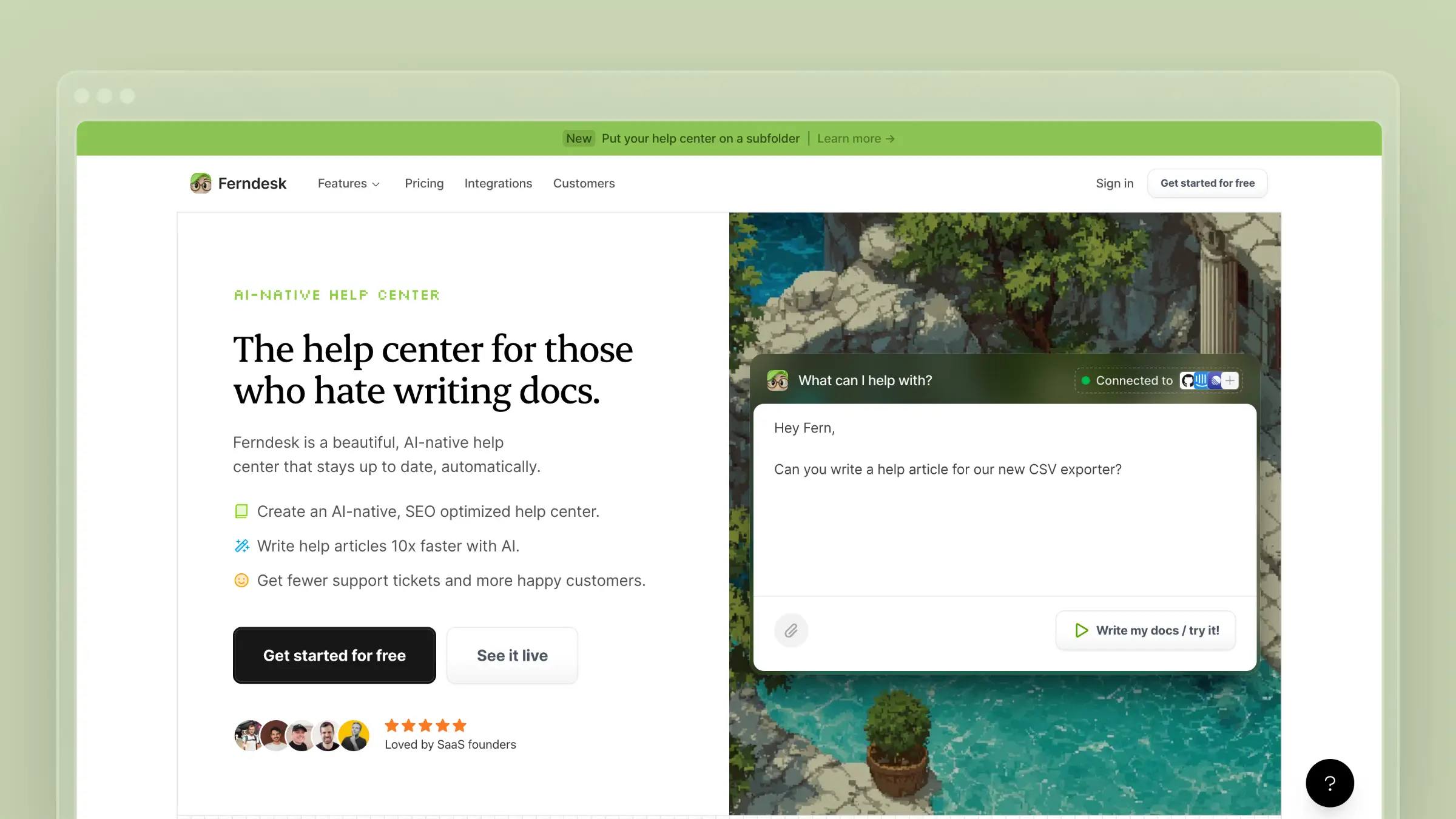
No infrastructure to manage. No builds to debug. No dependencies to update. You write documentation in a visual editor, or you let Fern draft it based on your codebase and support tickets.
The AI agent (Fern) does what Docusaurus can’t:
Watches your codebase. Connect GitHub, and Fern understands when features change. When your code renames a component or deprecates an API, Fern flags the articles that need updating. Docusaurus doesn’t know your code exists.
Analyzes support patterns. Fern reads your support conversations and identifies recurring questions. Then it drafts FAQs so your team stops answering the same thing repeatedly.
Audits for staleness. Weekly scans find broken links, outdated content, and articles that need attention. Docusaurus waits for users to complain.
The math is straightforward: Ferndesk Pro costs $149/month or $1,490/year and requires zero engineering time. Docusaurus costs $0 in software and $500-2,000/month in engineering labor.
Docusaurus is the right choice for open-source projects with volunteer contributors, or teams where documentation infrastructure is a strategic investment. For everyone else, try Ferndesk free and redirect those engineering hours toward building product.
Bottom Line
Docusaurus is excellent at what it does: building fast, customizable documentation sites for developer audiences. The docs-as-code workflow is genuine, the MDX support enables interactive content, and the community is strong.
But “free” is misleading. The real cost is engineering time: setup, maintenance, customization, and troubleshooting. For teams where that time is abundant or where documentation infrastructure is a strategic priority, Docusaurus delivers real value.
For everyone else, the hidden costs add up. A hosted solution that costs $50-100/month but requires zero engineering time is often cheaper than a “free” tool that demands regular attention.


 Book a demo